
TL;DR:
- Rewarded ads have over 80% completion rates because users voluntarily opt in to receive in-game rewards. They significantly improve player retention, spending, and conversion rates, making them a strategic tool for user acquisition. Effective deployment requires careful integration, technical orchestration, and targeted creative to maximize their benefits.
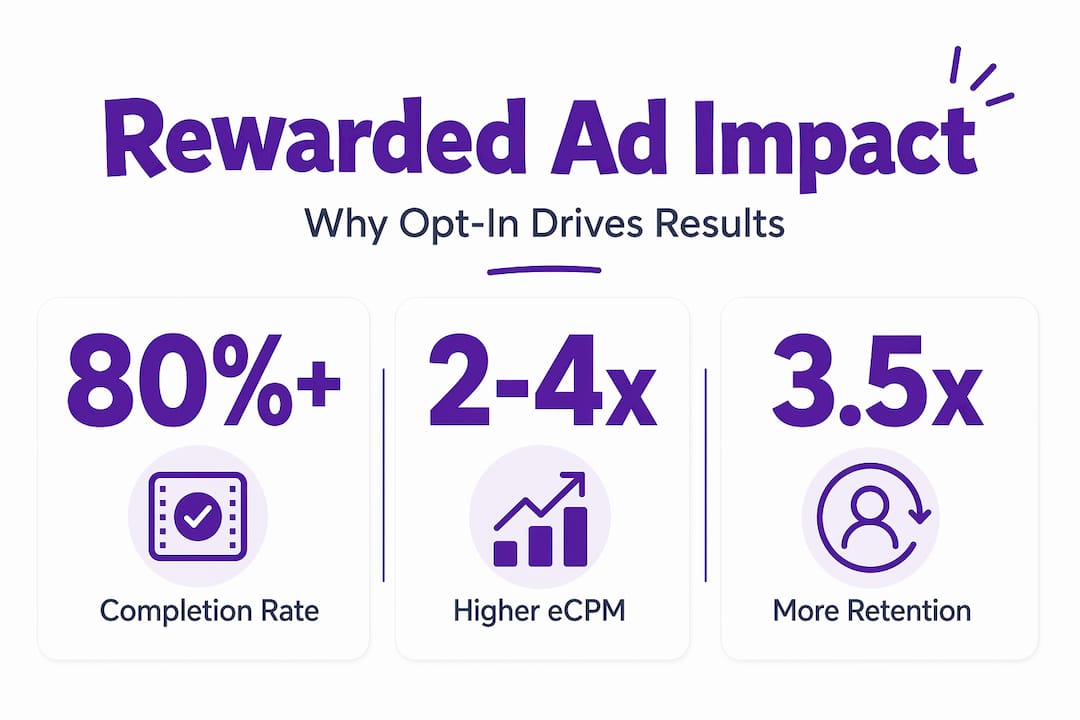
Rewarded ads achieve completion rates exceeding 80%, a figure that puts virtually every other mobile ad format to shame. Understanding what is a rewarded ad, and more importantly, why it performs so reliably, is no longer optional knowledge for user acquisition specialists in mobile gaming. It is a strategic necessity. This article covers the mechanics, the behavioural psychology, the hard performance data, and the implementation pitfalls, so you can deploy rewarded ad campaigns with genuine confidence rather than guesswork.
Table of Contents
- Key takeaways
- What is a rewarded ad?
- How rewarded ads work
- Performance benefits of rewarded ads
- Best practices for rewarded ad deployment
- Rewarded ads vs other mobile ad formats
- My perspective on rewarded ads and mobile monetisation
- Build better rewarded and playable ads with Playablemaker
- FAQ
Key takeaways
| Point | Details |
|---|---|
| Voluntary opt-in drives results | Rewarded ads depend on user choice, which is precisely why they outperform forced formats on every engagement metric. |
| eCPM is significantly higher | Rewarded video ads generate eCPM values 2 to 4 times higher than standard mobile ad formats. |
| Retention and spending improve measurably | Users who engage with rewarded ads show retention up to 3.5x higher and in-game spending increases averaging 326%. |
| Implementation complexity is underestimated | A centralised orchestration layer managing cooldowns and rate limits is required to maintain a consistent user experience. |
| Non-paying users can convert | Non-paying users who interact with rewarded ads are four times more likely to convert to in-app purchases. |
What is a rewarded ad?
A rewarded ad is an opt-in advertisement, most commonly a short video, that a user voluntarily chooses to watch in exchange for a clearly defined in-game reward. The word “rewarded” is doing precise work here. The user is not interrupted. They make an active choice. That single design decision separates rewarded ads from almost every other format in mobile advertising.
The reward structure varies considerably across mobile games. Common reward types include:
- In-game currency such as coins, gems, or tokens that can be spent within the game economy
- Extra lives or continues, allowing players to resume a level they would otherwise have to restart
- Power-ups or boosters that grant a temporary in-game advantage
- Premium content access, such as unlocking a chapter, character, or cosmetic item
- Ad-free breaks, granting the user a period of uninterrupted play after watching a single ad
Rewarded advertising is not limited to video alone. Rewarded playable ads, which invite the user to interact with a mini-version of another game before claiming a reward, are increasingly common. Rewarded surveys are also used, where answering a set of brand-related questions earns the user in-app credit. Each format preserves the core principle: the user’s time and attention are exchanged for something they genuinely want.
Half of gamers explicitly prefer rewarded video ads over other mobile ad formats. The reason is transparency. The value exchange is stated upfront. Watch this 30-second video, receive 50 coins. No ambiguity, no deception.
How rewarded ads work
The user journey through a rewarded ad is deliberately simple. A prompt appears at a natural moment in the game, typically after failing a level, running out of lives, or reaching a decision point. The user taps to opt in. They watch the full ad, often 15 to 30 seconds. Upon completion, the reward is delivered instantly. The entire sequence is designed to feel like a fair transaction, not an imposition.
That sense of fairness is not accidental. User control is central to why rewarded ads are psychologically effective. Behavioural research consistently shows that perceived autonomy increases compliance and satisfaction. When users feel they are choosing to engage rather than being forced to, their cognitive resistance to the ad drops substantially. They pay attention. They remember the brand.
Pro Tip: Place rewarded ad prompts at moments of genuine need within the game, for example immediately after a player fails a level for the second time. Contextual placement increases opt-in rates significantly compared to prompts that appear at arbitrary intervals.
On the technical side, the mechanics of rewarded ads are more complex than the user experience suggests. Effective implementation requires what developers call an orchestration layer. This layer manages cooldown periods between ad presentations, rate limits to prevent over-serving, and expiration logic to ensure rewards are only delivered when the ad has been fully and legitimately completed. Fragmented monetisation logic without this centralised policy layer leads to inconsistent user experiences and, worse, reward exploitation.
Reward balance is another dimension that warrants careful thought. Games that over-reward users devalue their own in-game economy. Weighted probability reward assignment addresses this by assigning different probabilities to different reward tiers. A player might have a 70% chance of receiving 20 coins, a 25% chance of receiving 50 coins, and a 5% chance of receiving a rare item. The game economy remains stable, yet users still perceive the reward as valuable and worthwhile.

Performance benefits of rewarded ads
The performance case for rewarded ads in mobile gaming is well documented and, frankly, difficult to argue against. The data across multiple metrics tells a consistent story.
| Metric | Rewarded ads | Standard formats |
|---|---|---|
| Ad completion rate | 80%+ | 30 to 50% |
| eCPM premium | 2 to 4x higher | Baseline |
| Retention rate impact | Up to 3.5x improvement | Minimal or neutral |
| In-game spending change | +326% average | Negligible |
| IAP conversion (non-payers) | 4x more likely | Baseline |
These figures warrant unpacking. The completion rate of 80%+ is a direct consequence of the opt-in model. Advertisers receive genuine, full-length impressions rather than half-watched interruptions. That audience quality justifies the premium advertisers pay, which in turn produces the elevated eCPM figures publishers enjoy.
The retention and spending numbers are where user acquisition specialists should pay particular attention. Users engaged with rewarded ads show retention 3.5 times higher and in-game spending increases averaging 326%, with peaks reaching 500% in some game categories. These are not marginal improvements. They represent a meaningful shift in player lifetime value.
The conversion finding for non-paying users is arguably the most strategically significant result of all. Players who have never spent money in a game are four times more likely to make their first purchase after engaging with rewarded ads. The hypothesis is that rewarded ads introduce non-payers to the feeling of premium content without requiring financial commitment. Once they experience that value, the psychological barrier to paying for it directly is reduced considerably.
Key performance benefits for UA specialists to consider:
- Rewarded ads deliver measurably higher return on ad spend compared to banners and interstitials
- The format supports both top-of-funnel awareness and bottom-of-funnel conversion within the same mechanic
- Brand recall improves because the voluntary nature of rewarded video creates active rather than passive viewing
- Publishers gain a monetisation channel that does not require users to spend money directly
Best practices for rewarded ad deployment
Understanding rewarded ads is one thing. Deploying them well is another. A number of implementation decisions separate high-performing rewarded ad experiences from those that frustrate users and undermine game economy.
-
Integrate rewards with your game economy from the outset. Bolting rewarded ads onto an existing game without accounting for reward inflation is a common mistake. Define the economic weight of each reward type before launch, not after.
-
Set frequency caps and respect them. Serving rewarded ads too often, even with a voluntary opt-in model, creates fatigue. Most well-managed games limit rewarded ad opportunities to three to five per session, depending on session length and game type.
-
Use rewarded ads in onboarding flows. New users who engage with a rewarded ad within their first session are significantly more likely to return. Offering a rewarded ad as part of the onboarding experience, for example a free power-up to use on the third level, introduces the mechanic before players feel they need it.
-
Experiment with reward types beyond currency. Ad-free breaks as a reward are an underused but highly effective option. Users who feel they earned an interruption-free experience, rather than paid for it, report higher satisfaction with both the game and the advertiser.
-
Centralise your monetisation policy logic. Managing cooldowns, suppression rules, and fallback behaviour through a single orchestration layer prevents the fragmentation that leads to inconsistent reward delivery and poor user experience.
-
Test ad creative specifically for rewarded placements. Rewarded ad inventory attracts a more attentive audience than standard formats. Generic creative wastes that attention. Ad engagement tactics designed for high-attention contexts will consistently outperform repurposed banner or interstitial creative.
Pro Tip: Segment your player base before deploying rewarded ad prompts. High-engagement players often respond better to exclusive content rewards such as rare cosmetics, while casual players respond better to functional rewards like extra lives. Personalised reward framing measurably improves opt-in rates.
Rewarded ads vs other mobile ad formats
Placing rewarded ads in context alongside other formats clarifies both their strengths and their appropriate use cases. No single format does everything, and understanding trade-offs is what separates thoughtful UA strategy from reflexive execution.
| Format | User sentiment | Completion rate | eCPM | Implementation complexity |
|---|---|---|---|---|
| Rewarded video | Positive (voluntary) | 80%+ | High | Moderate to high |
| Interstitial | Neutral to negative | 50 to 70% | Medium | Low |
| Banner | Generally negative | N/A (impressions) | Low | Very low |
| Playable | Positive (interactive) | High | High | High |
The comparison reveals a clear pattern. Formats that respect user attention, either through voluntary opt-in or interactive engagement, generate better metrics across the board. The trade-off is complexity. Rewarded ads require careful thought about reward design, game economy integration, and technical orchestration. Interstitials and banners are simpler to implement but deliver lower engagement and weaker revenue per impression. For a comprehensive view of all mobile ad formats available to gaming UA specialists, understanding how rewarded sits within that broader landscape is genuinely useful.
Rewarded ads are not a replacement for other formats. They are most effective when used alongside interstitials for mid-session monetisation and banners for persistent low-friction impressions. The distinctions matter when you are building a monetisation stack for a specific game type and player segment.
There are legitimate limitations to acknowledge as well. Rewarded ads require a game economy capable of absorbing regular reward distribution without inflating value. Games with shallow economies or no meaningful in-game currency struggle to implement them effectively. The format also demands higher-quality ad creative to justify the attentive viewing environment it creates.
My perspective on rewarded ads and mobile monetisation
I have watched rewarded ads move from a niche experiment to the dominant monetisation format in mobile gaming over the past several years. What strikes me most, looking back, is how consistently their strategic depth gets underestimated.
Most studios treat rewarded ads as a revenue line. A certain number of ad views per day, multiplied by eCPM, produces a predictable figure. That framing misses the larger point entirely. The more interesting number is the conversion rate of non-paying users to paying ones, and the role rewarded ads play in that shift. In my experience, the studios that grow most effectively treat every rewarded ad interaction as an introduction to premium content, not merely a source of advertising revenue.
The implementation challenges are also far more significant than most teams anticipate. Centralised orchestration, weighted reward probabilities, segment-based reward design. These are not afterthoughts. They determine whether a rewarded ad programme actually improves lifetime value or simply adds marginal ad revenue while slowly eroding user experience.
I think the future of rewarded advertising lies in deeper integration with gameplay itself, where the reward is not just a coin drop after an ad but a genuine narrative or mechanical moment that makes the game more enjoyable. Studios that figure out how to make the rewarded ad feel like a feature, not a monetisation layer, will hold a measurable advantage.
— Ondrej
Build better rewarded and playable ads with Playablemaker
If you are designing rewarded ad creative that needs to perform in high-attention placements, the quality of the ad itself matters enormously. At Playablemaker, we build tools for creating playable ads without requiring developer time or significant budget. Rewarded placements attract attentive users. Generic creative squanders that attention. Understanding the psychology behind ad effectiveness directly informs how you should build rewarded and playable formats that convert. Playablemaker’s no-code platform lets marketing teams move from brief to live creative quickly, keeping campaigns responsive to performance data without the typical production bottleneck.
FAQ
What is a rewarded ad in mobile gaming?
A rewarded ad is a voluntary, opt-in advertisement, typically a short video, that a mobile game user watches in exchange for an in-game reward such as currency, extra lives, or premium content. The defining characteristic is user choice: the player initiates the interaction rather than having it forced upon them.
Why do rewarded ads have higher completion rates?
Rewarded ads achieve completion rates exceeding 80% because users opt in deliberately to earn a reward, which means they are motivated to watch the full ad. This contrasts with interstitials and banners, where users are interrupted and have no incentive to pay attention.
How do rewarded ads affect player retention?
Users engaged with rewarded ads show retention rates up to 3.5 times higher than those who do not interact with them, alongside significant increases in in-game spending. The reward mechanic reinforces positive associations with the game, increasing the likelihood of return visits.
What eCPM can rewarded ads generate?
Rewarded video ads generate eCPM values 2 to 4 times higher than standard mobile ad formats. The premium exists because advertisers pay more for genuinely attentive, full-length impressions delivered to motivated audiences. For a deeper understanding of how eCPM works in mobile gaming, the underlying metric mechanics are worth examining carefully.
Can rewarded ads convert non-paying users to paying customers?
Yes. Non-paying users who interact with rewarded ads are four times more likely to make an in-app purchase compared to those who do not. Rewarded ads serve as a low-friction introduction to premium content, reducing the psychological barrier to direct spending.
Recommended
- Mobile ad formats for gaming UA: complete list 2026 – playablemaker.com Mobile ad formats for gaming UA: complete list 2026
- 5 mobile ad creative types to boost user acquisition – playablemaker.com 5 mobile ad creative types to boost user acquisition
- 7 Best Examples of Mobile Game Ads and Why They Work – playablemaker.com 7 Best Examples of Mobile Game Ads and Why They Work
- 7 Essential Types of In-Game Ads for Mobile App Success – playablemaker.com 7 Essential Types of In-Game Ads for Mobile App Success