Quick campaign launches often feel impossible for User Acquisition teams at smaller studios, especially with a limited budget. Yet, defining exact objectives and understanding who you are targeting is the step that shapes every successful playable ad. By focusing on both player demographics and psychographics, you gain the insights needed to deliver engaging experiences that drive meaningful results. This guide reveals how a cost-effective, no-code workflow helps you create interactive ads that resonate with gamers worldwide.
Table of Contents
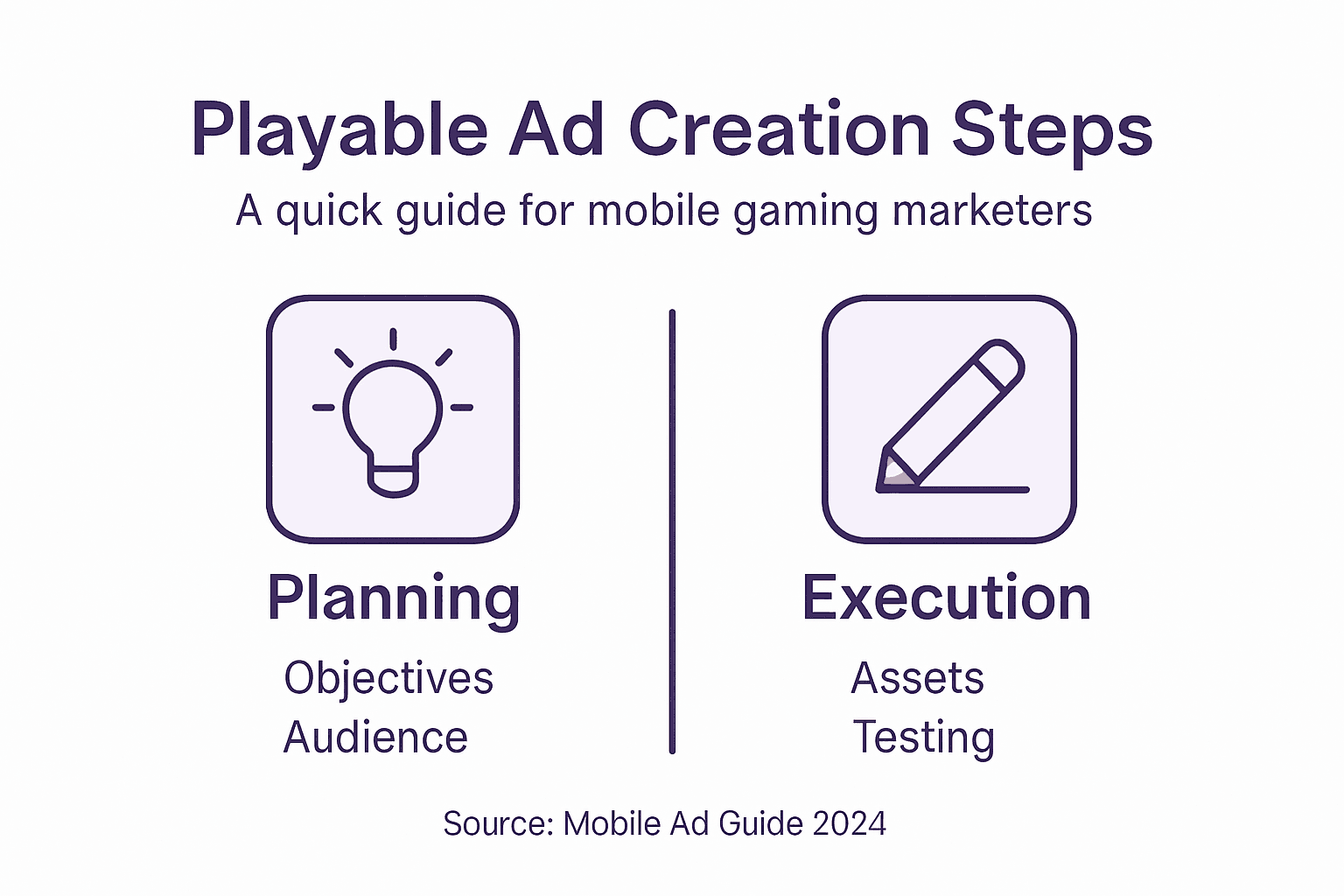
- Step 1: Define Campaign Objectives And Target Audience
- Step 2: Select Assets And Configure The No-Code Platform
- Step 3: Design Interactive Ad Mechanics And Visuals
- Step 4: Integrate Tracking And User Engagement Features
- Step 5: Test, Review And Optimise Playable Ad Performance
Quick Summary
| Main Insight | Detailed Explanation |
|---|---|
| 1. Define clear campaign objectives | Identify primary goals like increasing downloads or targeting demographics to create focused and effective ads. |
| 2. Understand audience demographics | Analyze location, age, and player motivations to tailor ad experiences that resonate with potential players. |
| 3. Select high-quality assets | Use game screenshots and character designs to create visually appealing ads that showcase the game’s core experience. |
| 4. Integrate user engagement tracking | Implement tracking features to monitor user interactions and gather insights for optimising the ad’s performance. |
| 5. Continuously test and refine ads | Create varied ad versions and analyse metrics to improve user engagement and conversion rates over time. |
Step 1: Define campaign objectives and target audience
Defining precise campaign objectives and understanding your target audience are foundational steps in creating successful playable ads for mobile gaming. By developing a clear strategy, you can craft engaging experiences that resonate with potential players and drive meaningful user acquisition.
To effectively define your campaign objectives, start by identifying your primary goals. These might include increasing game downloads, improving user retention, or targeting specific player demographics. Understanding player demographics involves examining multiple dimensions beyond basic characteristics:
- Location and geographic distribution
- Age range and gender
- Device preferences and technological capabilities
- Gaming experience and skill levels
- Player motivation and psychographic profiles
Demographics provide crucial insights into who might enjoy your mobile game. For instance, a strategy game might target males and females aged 25-45 with higher education levels and an interest in complex problem-solving. A casual puzzle game, conversely, could appeal to a broader age range seeking quick entertainment.
Psychographic segmentation becomes equally important. Consider player motivations like competition, social interaction, achievement, or storytelling. These deeper insights help you craft playable ads that genuinely connect with potential users.
Here is a comparison of demographic and psychographic segmentation approaches in mobile game marketing:
| Segmentation Approach | What It Involves | Example Insights | Business Impact |
|---|---|---|---|
| Demographic Segmentation | Analysing age, location, device | Identifies tech-savvy regions | Tailors ads to ideal audience |
| Psychographic Segmentation | Assessing motivations, values | Reveals players seeking challenge | Improves emotional ad resonance |
Precise audience targeting transforms generic advertisements into compelling interactive experiences that speak directly to players’ interests and desires.
Expert tip: Continuously analyse and refine your audience targeting based on initial ad performance metrics to incrementally improve your campaign effectiveness.
Step 2: Select assets and configure the no-code platform
Selecting the right assets and configuring your no-code platform are critical steps in creating compelling playable ads for mobile gaming. These actions will determine the visual appeal and interactive potential of your advertisement.
Begin by gathering high-quality visual and interactive assets that represent your game’s core experience. No-code technology in game design enables developers and marketers to rapidly prototype and deploy engaging ad experiences without extensive programming knowledge. Your asset selection should include:
- Game screenshots highlighting key gameplay moments
- Character designs or animations
- Brief video clips demonstrating unique game mechanics
- Compelling visual elements that capture player attention
- Interactive UI elements representative of your game
When configuring the no-code platform, focus on creating a seamless and intuitive ad experience. Ensure asset compatibility with the platform’s requirements, paying close attention to file formats, resolution, and size limitations. Most no-code platforms offer drag-and-drop interfaces that simplify the asset integration process.
Effective playable ads transform complex game mechanics into bite-sized, engaging experiences that immediately capture potential players’ interest.
Consider the user journey within your ad. Design a mini-gameplay sequence that provides a tantalising glimpse of your game’s core mechanics, allowing users to interact and experience the core value proposition within seconds.

Expert tip: Test multiple asset combinations and interactive configurations to identify which version generates the highest user engagement and conversion rates.
Step 3: Design interactive ad mechanics and visuals
Designing engaging interactive ad mechanics and visuals is crucial for capturing potential players’ attention and driving game installations. Your playable ad must quickly communicate the core excitement of your mobile game experience.
Best practices for playable ads emphasise creating intuitive, focused interactive experiences. When developing your ad’s mechanics and visuals, consider these strategic approaches:
- Limit interactive areas to 2-3 key elements per screen
- Develop clear, concise visual tutorials
- Create intuitive touch-based interactions
- Highlight unique gameplay mechanics
- Use vibrant, eye-catching visual design
- Implement responsive feedback mechanisms
Craft a compelling mini-gameplay sequence that provides an authentic snapshot of your game’s core experience. This means designing a 15-30 second interaction that demonstrates the most enjoyable aspects of your game, whether that’s solving a puzzle, battling an enemy, or exploring a unique world.
Interactive ads transform passive viewing into an immersive experience that directly invites players to engage with your game.
Consider the user’s first-time experience. Design an immediate, low-friction interaction that allows players to understand and enjoy your game’s mechanics within seconds. Visual and audio cues should guide users naturally, making the ad feel less like an advertisement and more like an exciting game preview.
Expert tip: Conduct multiple user testing rounds to refine your ad’s interactive elements, focusing on simplicity, engagement, and clear call-to-action pathways.
Step 4: Integrate tracking and user engagement features
Tracking and user engagement features are essential for understanding how your playable ad performs and optimising your mobile gaming marketing strategy. These sophisticated tools help you capture crucial insights about user interactions and ad effectiveness.
Playable ad engagement metrics provide actionable data points that transform raw user interactions into strategic marketing intelligence. When implementing tracking features, focus on capturing these key engagement indicators:
- Playtime duration
- User interaction rates
- Completion percentages
- Conversion metrics
- Specific interaction points
- User retention signals
Configure comprehensive tracking mechanisms that capture nuanced user behaviours without compromising the ad’s smooth user experience. This means embedding unobtrusive tracking pixels and event listeners that record interactions seamlessly.
Effective tracking transforms passive ad viewing into a rich, data-driven user acquisition strategy.
Design intuitive engagement elements that naturally encourage user interaction. These might include subtle reward mechanisms, progressive difficulty curves, or interactive prompts that feel like natural extensions of the gameplay experience rather than explicit tracking interventions.
Expert tip: Regularly review and recalibrate your tracking parameters, ensuring you capture evolving user interaction patterns without overwhelming your analytics infrastructure.
Step 5: Test, review and optimise playable ad performance
Testing, reviewing, and optimising your playable ad performance is a critical process that transforms initial designs into high-converting marketing assets. This iterative approach ensures your mobile gaming advertisement continuously improves and delivers maximum user acquisition results.
Implement a comprehensive testing strategy that evaluates multiple performance dimensions. Establish clear benchmarking metrics to measure your ad’s effectiveness, including:
- Conversion rates
- User engagement duration
- Interaction completion percentages
- Install rate after ad interaction
- User retention post-installation
- Cost per acquisition
Create controlled experimental variations of your playable ad to understand which elements drive user engagement. This might involve testing different visual styles, gameplay mechanics, tutorial approaches, or call-to-action placements. Systematically compare these variations to identify the most compelling version.
Performance optimisation is not a single event, but a continuous refinement process that demands strategic, data-driven decision-making.
Utilise advanced analytics tools to track granular user interactions. Analyse user drop-off points and identify friction areas that might prevent potential players from completing the ad experience or installing your game. Each piece of data provides an opportunity to incrementally enhance your advertisement’s effectiveness.
Below is a summary of key metrics and their significance in playable ad performance analysis:
| Metric | What It Measures | Why It Matters |
|---|---|---|
| Playtime Duration | How long users engage | Indicates ad interest level |
| Conversion Rate | Number installing after play | Reflects ad effectiveness |
| User Retention Post-Install | Continued game usage after ad | Shows quality of user acquired |
Expert tip: Develop a regular testing schedule, allocating specific time intervals for comprehensive performance review and implementing data-driven improvements to your playable ad strategy.
Simplify Your Playable Ad Creation with PlayableMaker
Creating engaging playable ads for mobile gaming can feel overwhelming. From defining precise campaign objectives to designing interactive ad mechanics and integrating tracking features you need a solution that saves time and cuts costs without sacrificing quality. The challenge lies in translating complex game mechanics into intuitive, attention-grabbing experiences quickly and budget-friendly.
PlayableMaker offers the perfect no-code platform to bring your playable ad concepts to life rapidly. Our tools empower you to select and configure your assets easily while designing compelling interactive sequences that resonate with your target audience. With built-in tracking and optimisation capabilities you can continuously improve user engagement and conversion rates. Explore detailed guidance and practical support in our Help Archives and discover how to publish your best ads effortlessly in our Publishing Archives.
Don’t let lengthy development cycles or hefty budgets hold you back. Start building your next high-impact playable ad today at PlayableMaker and transform your mobile gaming marketing strategy with speed and confidence.
Frequently Asked Questions
What are the key steps in creating playable ads for mobile gaming?
To create effective playable ads, follow these key steps: define your campaign objectives and target audience, select the right assets for your ad, design engaging interactive mechanics and visuals, integrate tracking and user engagement features, and continuously test, review, and optimise ad performance. Start with a clear strategy to ensure your ad resonates with potential players.
How can I identify my target audience for mobile gaming ads?
Identify your target audience by examining factors such as demographics, device preferences, gaming experience, and player motivations. Conduct research into where your potential players are and what gaming experiences they seek, and then tailor your ads to connect with their interests effectively.
What types of assets should I use for my playable ads?
Use high-quality visual and interactive assets that represent your game’s core experience. Consider including game screenshots, character designs, brief gameplay clips, and engaging UI elements to attract attention and entice users to engage with your ad.
How can I track the performance of my playable ads?
Implement comprehensive tracking mechanisms that capture user behaviour metrics such as playtime duration, interaction rates, and conversion metrics. Regularly review these data points to identify patterns and make informed adjustments to enhance your ad’s effectiveness.
What are the best practices for designing interactive mechanics in ads?
Design your interactive mechanics by limiting the interactive areas to 2-3 key elements per screen and developing clear visual tutorials. Focus on creating intuitive touch-based interactions that highlight your game’s unique mechanics, ensuring they are engaging and easy to understand for users.
How do I optimise the performance of my playable ads?
Optimise ad performance by conducting regular tests to evaluate different variations of your playable ad. Analyse key metrics such as conversion rates and user engagement, and implement data-driven improvements based on your findings to enhance user acquisition results.
Recommended
- Master Effective Ad Creative Processes for Mobile Gaming – playablemaker.com Master Effective Ad Creative Processes for Mobile Gaming
- Mastering Mobile Playable Ad Workflow for Gaming Success – playablemaker.com Mastering Mobile Playable Ad Workflow for Gaming Success
- Master the Dynamic Ad Creative Process for Mobile Gaming – playablemaker.com Master the Dynamic Ad Creative Process for Mobile Gaming
- Master the Playable Ad Iteration Process for Mobile Games – playablemaker.com Master the Playable Ad Iteration Process for Mobile Games
- UI/UX Designer – ThunderHosting