
TL;DR:
- Optimal ad frequency balances reaching users enough times to build recall without causing fatigue or avoidance, making it a critical factor in mobile app campaigns. The ideal number of exposures depends on campaign goals, audience segmentation, and vertical benchmarks, with shorter windows and lower caps for cold audiences and higher for retargeting. Using automated signals and creative rotation strategies prevents performance decline, emphasizing that frequency management is a dynamic process, not just setting a fixed cap.
Optimal ad frequency is the specific number of times a user should see your ad within a given window to drive conversions without triggering fatigue or brand avoidance. Get it wrong in either direction and you pay the price. Show ads too rarely and you fail to build recall. Show them too often and 61% of consumers actively avoid the brand. For mobile app marketers running user acquisition campaigns on Meta, TikTok, or programmatic networks, frequency is one of the most consequential variables in your entire media plan.
What is optimal ad frequency and why does it matter?
Optimal ad frequency, known in media planning as the effective frequency, sits at the intersection of reach efficiency and audience tolerance. The concept draws on Krugman’s three-exposure theory, which holds that a consumer needs at least three exposures to process, evaluate, and act on an ad. The practical reality for mobile app campaigns is more nuanced than that single number suggests.
Digital brand recall increases significantly between the first and third exposure, peaking somewhere between three and seven total impressions. After eight to ten views, negative brand sentiment begins to rise. This means your window of effective repetition is narrower than most default campaign settings assume.
Campaigns with managed impression frequency deliver a 20–30% better ROI than uncontrolled ones, according to eMarketer’s 2025 report. That gap reflects the compounding cost of wasted impressions and the brand damage that accumulates when users are overexposed. Understanding ad frequency in mobile marketing is therefore not a technical detail. It is a commercial priority.
How does ideal ad frequency vary by campaign goal and vertical?
The single biggest mistake mobile app marketers make is applying one frequency cap across every campaign type. Frequency tolerance varies substantially depending on where a user sits in the funnel and which vertical you operate in.

The table below summarises recommended weekly frequency ranges by campaign objective, based on data from Improvado’s 2026 frequency capping research:
| Campaign objective | Recommended weekly frequency |
|---|---|
| Brand awareness | 1–3 impressions per user |
| Consideration | 3–5 impressions per user |
| Lead generation | 4–8 impressions per user |
| Sales and conversion | 5–10 impressions per user |
| Retargeting (short bursts) | 8–12+ impressions per user |
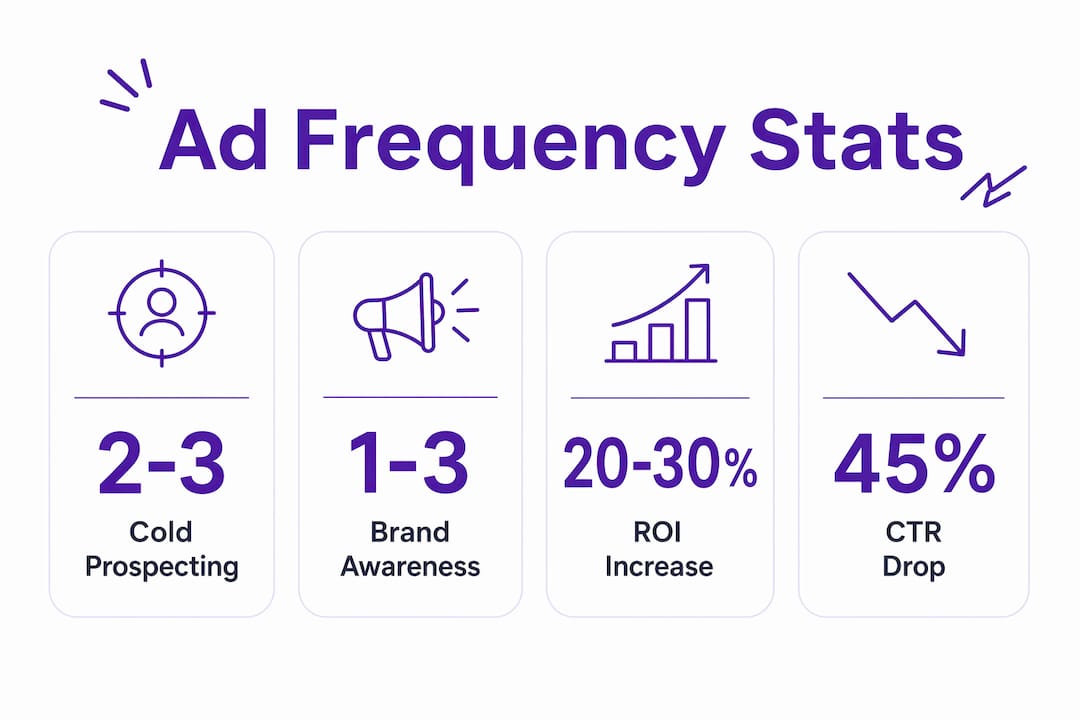
These frequency ranges by objective reflect how purchase intent and decision complexity shape tolerance. A user who has already visited your app store page can absorb more impressions before fatigue sets in than a cold prospect seeing your brand for the first time.
Vertical benchmarks add another layer of precision:
- Ecommerce and mobile gaming: 2.5–3.5 impressions per week. These audiences are accustomed to high ad volumes and respond well to visual variety, but they saturate quickly when creative is repetitive.
- SaaS and subscription apps: 3.5–5.0 per week. Longer consideration cycles mean users tolerate more touchpoints before making a decision.
- Lead generation campaigns: CPL increases of 20–30% appear when frequency exceeds 3.0 per week, making tight caps non-negotiable in this vertical.
For cold prospecting on Meta specifically, the recommended cap is 2–3 impressions per user weekly. CTR drops 45% after four exposures in cold audiences, which is a clear signal that the marginal value of each additional impression collapses rapidly beyond that threshold.
How to identify ad fatigue before it damages performance
Ad fatigue rarely arrives as a sudden cliff. It accumulates gradually across a campaign, which is precisely why reactive monitoring is insufficient. You need pre-set rules that flag deterioration before it compounds.
The most reliable early indicators of frequency-driven fatigue are:
- CTR decline of 15–20% over seven days. A drop of this magnitude, correlated with rising frequency, points to creative exhaustion rather than audience mismatch.
- CPA or CPL increase of 5–8% over the same window. Rising acquisition costs at stable spend levels indicate that impressions are converting less efficiently.
- Meta’s Creative Fatigue indicator. Facebook Ads Manager surfaces this signal directly within the ad set view when an ad is reaching the same users too often with diminishing returns.
- Frequency velocity. If your average frequency is climbing faster than your reach is growing, your budget is concentrating on a shrinking pool of users. This is a structural warning sign, not just a creative one.
Setting automated fatigue flags for a 5–8% CPA increase or 15–20% CTR drop over seven days allows you to trigger creative refreshes before performance deteriorates materially. Reactive fixes cost more because you are already paying for wasted impressions by the time you act.
Pro Tip: Set up automated rules in Facebook Ads Manager or your preferred DSP to pause or flag ad sets the moment CPA rises 7% week-on-week at a frequency above 3.5. This removes the need for daily manual checks and catches fatigue at the earliest measurable point.
Understanding the difference between creative fatigue and pure frequency overload is also critical here. The two are related but not identical, and conflating them leads to the wrong fix.
What are the best ad frequency strategies for mobile campaigns?
Effective frequency management is not simply a matter of setting a cap and leaving it. The most consistent performers in mobile user acquisition treat frequency as a dynamic variable, adjusted by funnel stage, audience segment, and creative pipeline depth.
-
Set frequency caps by funnel stage. Cold prospecting audiences on Meta or TikTok should be capped at 2–3 impressions per week. Warm audiences who have engaged with your app store listing or website can tolerate 4–6. Retargeting segments, particularly cart abandoners within the first three days, can absorb 8–12 impressions in short bursts without significant fatigue.
-
Segment audiences by intent decay. Cart abandoners within 0–3 days need higher, more urgent frequency than visitors from 15–30 days prior. A user who abandoned your app install flow yesterday is far more receptive to a repeated message than someone who browsed your landing page three weeks ago. Applying a single cap to both groups wastes budget on the latter and under-serves the former.
-
Build a creative rotation cadence. Frequency caps alone buy time. They do not solve the underlying problem if the creative pipeline is thin. For cold prospecting, rotate fresh creative angles on a weekly basis. For warm and retargeting audiences, rotate every 10–14 days. Each rotation should introduce a meaningfully different angle, not just a colour or copy tweak.
-
Avoid one-size-fits-all caps. Applying a single frequency setting across all ad sets, regardless of audience temperature or campaign objective, is one of the most common and costly errors in mobile UA. A cap of 3 per week that protects a cold audience will under-deliver for a retargeting campaign where higher frequency is commercially justified.
-
Account for budget-to-audience ratio. A £5,000 weekly budget against an audience of 50,000 users will produce very different frequency dynamics than the same budget against 500,000 users. Frequency is partly a function of how tightly your budget concentrates on a given pool. Expanding your audience size is sometimes the most efficient way to reduce frequency without sacrificing reach.
For Meta ads creative strategy, pairing frequency discipline with a structured creative testing process consistently outperforms frequency management in isolation.
Pro Tip: When launching a new mobile app campaign on Meta, start with a frequency cap of 2 per week for cold audiences and review after seven days. If CTR holds above your baseline and CPA is stable, test incrementally raising to 3. This staged approach gives you clean data rather than guessing at the right number from day one.
What tools and metrics help you measure and refine frequency?
Measuring frequency impact accurately requires more than glancing at the average frequency figure in your dashboard. That single number masks the distribution of exposures across your audience, which is where the real insight lives.
The following tools and methods give you a more complete picture:
- Facebook Ads Manager frequency buckets. The breakdown report in Meta allows you to segment performance by frequency bucket (users who saw the ad once, twice, three times, and so on). This reveals exactly where CTR and conversion rate begin to decline, giving you an empirical basis for your cap rather than a rule-of-thumb.
- A/B testing frequency caps. Run two identical campaigns against matched audiences with different frequency caps, for example 2 per week versus 4 per week, and measure CPA, CTR, and install rate over 14 days. The results will often surprise you and will be specific to your audience and creative.
- Automated frequency dashboards. Tools such as Improvado and third-party attribution platforms allow you to build frequency monitoring dashboards that surface anomalies across multiple campaigns simultaneously. This is particularly useful when managing large portfolios of mobile app campaigns.
- Brand lift studies. For awareness-stage campaigns, frequency optimisation should be validated against brand recall metrics, not just CTR. Meta’s Brand Lift product and third-party providers measure incremental recall at different frequency levels, giving you data that standard media mix models sometimes misrepresent due to S-curve assumptions.
- Reach versus frequency trade-off analysis. When frequency is rising and reach is flat, you are not growing your addressable pool. Monitoring the ratio of unique reach to total impressions weekly tells you whether your budget is working efficiently or concentrating on a saturated segment.
Connecting these signals to your ad recall measurement process gives you a fuller view of whether frequency is building memory or eroding goodwill.
Key takeaways
Optimal ad frequency requires pairing precise frequency caps with a structured creative rotation cadence, segmented by funnel stage and audience intent, to sustain performance without wasted spend.
| Point | Details |
|---|---|
| Frequency varies by funnel stage | Cold audiences need 2–3 impressions weekly; retargeting can absorb 8–12 in short bursts. |
| Vertical benchmarks matter | Lead gen CPL rises 20–30% above 3 impressions per week; SaaS tolerates up to 5. |
| Fatigue signals are measurable | Flag a 15–20% CTR drop or 5–8% CPA rise over seven days to trigger creative rotation. |
| Caps alone are insufficient | Frequency caps buy time; a weekly creative rotation cadence is what sustains performance. |
| Audience segmentation sharpens results | Intent decay timelines determine appropriate caps; recent abandoners tolerate higher frequency than older visitors. |
Why I think most marketers are solving frequency backwards
Most frequency conversations I encounter start with the cap. Marketers set a number, usually 3 or 5, and treat that as the solution. The cap is not the solution. It is a constraint that buys you time to do the actual work, which is building a creative pipeline deep enough to rotate meaningfully.
The data supports this. High frequency signals poor creative far more often than it signals an audience that has simply seen enough. When a campaign fatigues at a frequency of 2.5, the problem is almost never that the user saw the ad too many times. The problem is that the ad gave them no reason to respond differently on the second or third view.
What I have found genuinely useful is treating creative rotation as a media planning input, not an afterthought. Before a campaign launches, map out six to eight distinct creative angles. Assign each a rotation slot. Set your frequency cap to align with how long each angle can sustain performance before the next one enters. This turns frequency management from a defensive tactic into a structured system.
The other underused lever is audience segmentation by intent decay. Most campaigns I review apply the same cap to users who abandoned an install flow yesterday and users who clicked an ad three weeks ago. These are fundamentally different audiences with different receptivity levels. Treating them identically wastes budget on the former and misses opportunity with the latter.
One caution: Google researchers have questioned whether the industry’s frequency orthodoxy overestimates the value of repetition relative to reach. The first impression delivers the largest marginal value. Every subsequent impression delivers less. That does not mean repetition is worthless, but it does mean the burden of proof for high-frequency strategies is higher than most campaign settings imply.
— Ondrej
How playable ads support smarter frequency management
Playable ads are one of the most practical tools for extending the effective life of a frequency-managed campaign. Because they are interactive, users engage with them differently than static or video formats. A single playable ad unit can sustain attention across multiple exposures without the same rate of fatigue, because the experience varies with each interaction.
For mobile app marketers, this means fewer creative refreshes are needed to maintain performance at a given frequency level. Playablemaker’s no-code platform lets you build and iterate playable ad formats quickly, without developer resource or large production budgets. If you are running frequency-sensitive campaigns and want to understand why interactive formats hold up better under repetition, the psychology behind playable ads is worth reading before your next creative refresh cycle.
FAQ
What is a good ad frequency for mobile app campaigns?
A good ad frequency for cold prospecting on Meta is 2–3 impressions per user per week. Retargeting audiences can tolerate 8–12 impressions in short bursts, while awareness campaigns perform best at 1–3 weekly exposures.
How often should you show ads to avoid fatigue?
Ad fatigue typically begins when frequency exceeds 4 exposures for cold audiences, with CTR dropping 45% after that threshold on Meta. Monitoring for a 15–20% CTR decline over seven days is the most reliable early warning signal.
Does higher frequency always improve conversions?
Higher frequency does not reliably improve conversions beyond a certain point. Brand recall peaks between 3 and 7 total exposures, and negative sentiment rises after 8–10 views, meaning additional impressions beyond that range often reduce rather than increase conversion likelihood.
How do frequency caps differ across platforms?
Meta recommends 2–3 weekly impressions for cold prospecting, while programmatic platforms and TikTok allow more granular cap settings by placement and audience segment. The right cap depends on your campaign objective, vertical, and creative rotation cadence rather than platform defaults alone.
Should you use the same frequency cap for all ad sets?
Applying a single frequency cap across all ad sets is a common error. Frequency tolerance varies by funnel stage, audience intent, and vertical, so each ad set should carry a cap calibrated to its specific audience temperature and campaign objective.
Recommended
- Mobile ad optimisation tips for UA professionals – playablemaker.com Mobile ad optimisation tips for UA professionals
- Top mobile ad platforms for gaming user acquisition – playablemaker.com Top mobile ad platforms for gaming user acquisition
- Understanding What is Ad Frequency in Mobile Marketing – playablemaker.com Understanding What is Ad Frequency in Mobile Marketing
- What Is Facebook Ad Frequency? Complete Guide – playablemaker.com What Is Facebook Ad Frequency? Complete Guide