
TL;DR:
- Native advertising seamlessly blends paid content with platform design according to IAB standards, improving engagement and CTR. It outperforms traditional display ads by matching content flow, increasing trust, and delivering higher CPMs, especially with well-targeted, quality content. Success relies on content quality, transparency with disclosures, systematic testing, active placement management, and comprehensive performance measurement.
Native advertising is defined as paid placement that matches the form and function of the host platform, making it indistinguishable in style from the surrounding editorial content. According to IAB 2026 standards, native ads must satisfy two core pillars: form, meaning the ad mirrors the host’s visual design and layout, and function, meaning it behaves like the content around it. The U.S. native advertising market is projected at $147.98 billion in 2026, growing at 13.1% annually. That figure reflects how decisively marketers have shifted budget toward formats that audiences actually engage with. Common native ad formats include in-feed placements, sponsored articles, recommendation widgets, and branded social content.
Native ads explained: types, formats, and key differences
Understanding the full range of native ad formats is the first step toward choosing the right one for your campaign objectives. Each format serves a distinct purpose, appears in a different context, and suits different stages of the marketing funnel.

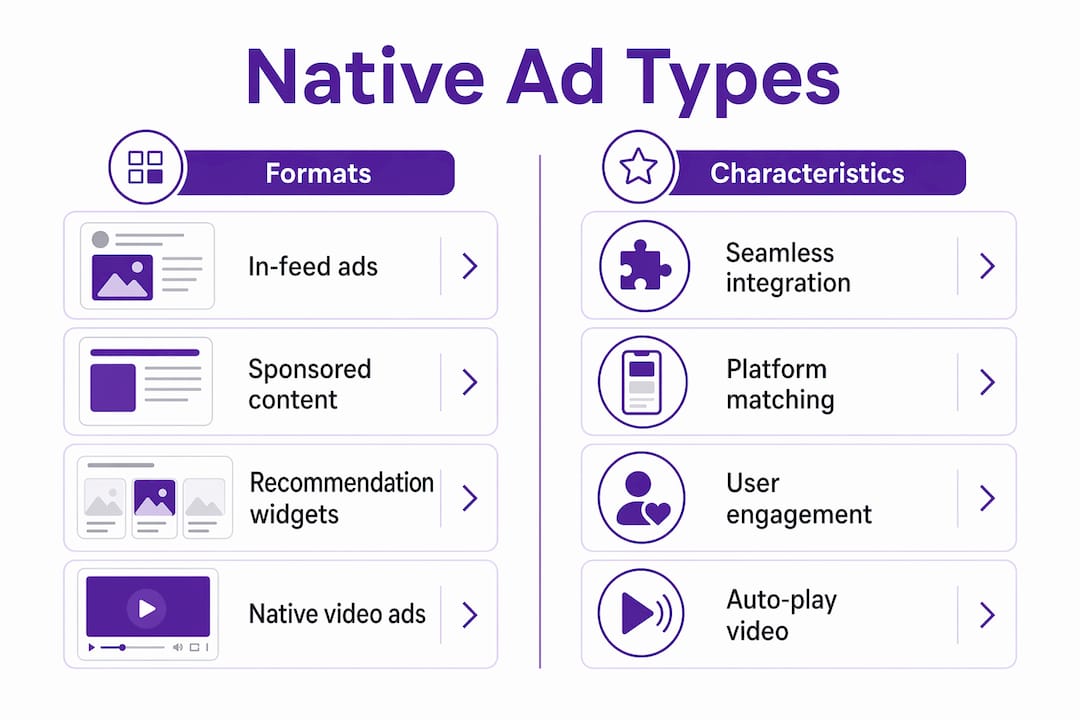
In-feed ads appear directly within a content stream, such as a social media timeline or a news site’s article list. They carry the same visual weight as organic posts and are the most widely used native format. Platforms such as Meta, LinkedIn, and X (formerly Twitter) all operate in-feed native placements at scale.
Sponsored articles and branded content are longer-form pieces published on editorial sites. A financial brand might commission a 1,000-word explainer on The Guardian or Forbes that reads like journalism but carries a “Sponsored” label. These work well for brand awareness and thought leadership objectives.
Recommendation widgets appear at the bottom of articles under headings such as “You may also like” or “Recommended for you.” Networks like Taboola and Outbrain power the majority of these placements across publisher sites. They drive traffic efficiently but require strong headline copy to generate clicks.
Native video ads auto-play within content feeds without interrupting the user’s session. They perform particularly well on mobile, where full-screen interstitials create friction. Branded filters and augmented reality placements on Snapchat and TikTok represent the newest category, blending user-generated behaviour with paid promotion.
The table below summarises the main native ad types and their distinguishing characteristics.
| Format | Typical placement | Primary strength | Best suited for |
|---|---|---|---|
| In-feed ads | Social feeds, news streams | High visibility, natural scroll | Awareness and direct response |
| Sponsored articles | Editorial websites | Depth, credibility, SEO value | Brand authority, consideration |
| Recommendation widgets | End-of-article sections | Scale, cost-efficient traffic | Content distribution, retargeting |
| Native video | Social and content feeds | Emotional engagement, recall | Brand storytelling |
| Branded filters/AR | Snapchat, TikTok | User participation, shareability | Youth audiences, product launches |
Choosing between these formats depends on your audience’s platform behaviour, your creative assets, and the funnel stage you are targeting. A performance marketer focused on direct response will prioritise in-feed and widget placements. A brand team building long-term equity will lean toward sponsored editorial and native video.
How do native ads work to overcome banner blindness?
Banner blindness is the documented tendency of users to ignore display ads because their brains have learned to filter out rectangular blocks in predictable screen positions. Studies confirm that native ads overcome banner blindness by blending into the natural content flow, which keeps the user’s attention on the page rather than triggering the automatic ignore response.
The psychological mechanism is straightforward. When an ad matches the visual rhythm and informational style of the surrounding content, the brain processes it as part of the reading experience rather than as an interruption. This reduces ad fatigue and increases the probability that the user reads, clicks, or engages. Native ads achieve an average CTR of 0.20%, four times higher than conventional display ads at 0.05%. That performance gap is not marginal. It compounds significantly across large impression volumes.
Ethical compliance is non-negotiable within this format. Native ads require prominent disclosures such as “Ad”, “Sponsored”, or “Promoted” labels that are visible before user engagement. Transparency protects both the advertiser’s credibility and the publisher’s trust relationship with its audience. Omitting disclosures does not improve performance. Research consistently shows that audiences who feel deceived disengage entirely and develop negative brand associations.
Pro Tip: Place your disclosure label at the top of the ad unit, not the bottom. Users scan from the top down, and a visible label before engagement builds trust rather than eroding it.
The key behavioural factors that make native ads work include:
- Content alignment: the ad topic matches what the user is already reading or watching
- Visual consistency: fonts, colours, and layout mirror the host platform’s design system
- Non-interruptive delivery: the ad appears within the natural scroll path, not as a pop-up or overlay
- Relevance signals: targeting ensures the ad reaches users whose interests match the content
What are the benefits of native advertising compared to traditional digital ads?
The benefits of native advertising extend beyond click-through rates. The format improves brand perception, publisher revenue, and audience quality simultaneously.
Traditional display ads operate on an interruption model. They compete for attention by being louder, larger, or more intrusive than the content around them. Native advertising operates on a relevance model. It earns attention by being genuinely useful or interesting to the user at that moment. This distinction matters because digital marketing challenges such as ad fatigue, ad blocking, and declining display CPMs are all symptoms of the interruption model failing at scale.
From a publisher’s perspective, native placements command higher CPMs than standard display because advertisers pay a premium for contextual relevance and engagement quality. Publishers who integrate native formats well report stronger reader retention alongside improved advertising revenue.
The table below compares native and traditional display advertising across the metrics that matter most to performance marketers.
| Metric | Native advertising | Traditional display |
|---|---|---|
| Average CTR | 0.20% | 0.05% |
| Ad fatigue rate | Lower (content-aligned) | Higher (interruptive format) |
| Brand perception impact | Positive (relevance-driven) | Neutral to negative (intrusive) |
| Publisher CPM | Higher | Lower |
| Ad blocker vulnerability | Lower | Higher |
Consumer trust is another measurable advantage. Audiences exposed to native formats report higher brand recall and more favourable attitudes toward the advertiser compared to those exposed to banner ads. This is because the format signals that the brand understands the audience’s context rather than simply buying their attention.
How can marketers create and optimise effective native ad campaigns?
Effective native ad campaigns require systematic creative testing, precise placement management, and a funnel architecture that converts engaged readers into customers.
Follow this sequence when building a native campaign from scratch:
- Define your funnel stage. Native ads work at every stage, but the creative and landing page must match the user’s intent. Awareness campaigns need editorial-style content. Conversion campaigns need tightly focused landing pages.
- Build modular creative assets. Modular creative assets allow you to refresh content dynamically and avoid creative fatigue. Produce multiple image variants and headline options rather than a single static execution.
- Test 5 to 10 headline variations upfront. Testing multiple headline variations is the single most effective tactic for combating creative fatigue, which occurs faster in native than in most other formats. Headlines drive the majority of click decisions in native placements.
- Use pre-landers to warm traffic. Pre-landers enhance conversion rates by preparing users before they reach the final offer. A pre-lander might be a short editorial piece, a quiz, or a problem-solution article that bridges the native ad’s content and the product page.
- Manage placements actively. Whitelisting and blacklisting placements improves campaign profitability by eliminating underperforming publisher sources. Review placement-level data weekly during the first month of any campaign.
- Track beyond last-click attribution. Engagement depth, time on page, and brand lift surveys capture native advertising’s true impact more accurately than last-click models, which systematically undervalue upper-funnel formats.
Pro Tip: Set automated pause rules on ad groups where CPC exceeds your target by 30% for three consecutive days. This prevents budget waste while you identify the root cause, whether that is a weak headline, a poor placement, or a misaligned landing page.
The metrics to monitor throughout a native campaign are CTR at the ad level, conversion rate at the landing page level, CPC relative to your target, and return on ad spend at the campaign level. Optimising these four metrics in sequence gives you a clear diagnostic path from creative to conversion.
You can explore creative ad format strategies to understand how native placements fit within a broader mobile creative mix.
Examples of successful native advertising campaigns
Real-world native advertising examples illustrate how the format performs across industries and platforms when executed with content quality as the primary consideration.
- The New York Times and Netflix: Netflix partnered with The New York Times T Brand Studio to produce a sponsored article on women in prison that aligned directly with the launch of Orange Is the New Black. The piece read as genuine journalism and generated substantial organic sharing. It succeeded because the content served the reader’s interest first and the advertiser’s interest second.
- BuzzFeed and Purina: Purina sponsored a BuzzFeed article featuring a dog owner’s story told from the dog’s perspective. The piece accumulated millions of views and thousands of social shares. The format matched BuzzFeed’s editorial voice precisely, making the sponsorship feel like a natural fit rather than an intrusion.
- Taboola widget campaigns for e-commerce: Performance marketers running widget placements through Taboola consistently report that editorial-style headlines (“What dermatologists actually use on their skin”) outperform product-forward headlines (“Buy our skincare range now”) by significant margins. The lesson is that native ad copy must earn the click through curiosity or utility, not through direct sales language.
- LinkedIn sponsored content for B2B: LinkedIn’s in-feed native placements allow B2B advertisers to distribute thought leadership articles directly within the professional content stream. Campaigns that lead with data or counter-intuitive insights consistently outperform those that lead with product claims.
The common thread across these examples is content quality. Native ad success depends on content quality and alignment with reader interests, not on distribution volume or placement count alone. Measurement frameworks that go beyond last-click attribution such as engagement depth and brand lift better capture the true impact of these campaigns.
Key takeaways
Native advertising outperforms traditional display because it earns attention through relevance rather than competing for it through interruption, and this distinction drives every strategic decision from creative to measurement.
| Point | Details |
|---|---|
| Definition and standards | Native ads must match both the form and function of the host platform, per IAB 2026 guidelines. |
| Performance advantage | Native ads deliver a 0.20% average CTR, four times higher than standard display at 0.05%. |
| Creative testing | Test 5 to 10 headline variations upfront to combat creative fatigue, which accelerates in native formats. |
| Placement management | Whitelist and blacklist publisher placements weekly to protect campaign profitability and ROI. |
| Measurement approach | Use engagement depth and brand lift metrics alongside CTR to capture native advertising’s full value. |
Why most native ad campaigns underperform, and what I have learned
The most persistent mistake I see in native advertising is treating it as a distribution channel rather than a content discipline. Advertisers upload a product image, write a promotional headline, and wonder why their CTR is poor and their conversion costs are high. Native advertising is not a faster route to a sales page. It is a format that rewards editorial thinking.
The second mistake is neglecting transparency. Some advertisers still believe that minimising the “Sponsored” label improves performance. The data does not support this. Audiences who feel misled do not convert. They bounce, and they carry a negative brand association with them. Ethical disclosure is not a regulatory burden. It is a trust signal that improves long-term campaign performance.
What actually works, in my experience, is a content-first brief. Before writing a single headline, ask what the reader would genuinely find useful or interesting at the moment they encounter this ad. Then build the creative around that answer. The product or service becomes the natural conclusion of a useful piece of content rather than the opening demand.
The future of native advertising will be shaped by AI-generated personalisation at scale, interactive formats, and tighter integration between editorial and advertising teams. Marketers who invest in content quality now are building a capability that will compound in value as the format matures. Those who treat it as a cheaper display channel will continue to see mediocre results regardless of their budget.
— Ondrej
Take native advertising further with playable ads
Native advertising builds engagement by matching content to context. Playable ads take that principle further by making the ad itself an interactive experience. If you are running native campaigns for mobile apps, games, or consumer products, playable ads add a participation layer that native formats alone cannot provide. Users play a mini-version of your product before clicking through, which improves intent quality and reduces post-install churn. Playablemaker lets you build these interactive units without developer resources or large production budgets. You can also explore the psychology behind playable ads to understand why participation-driven formats consistently outperform passive ones in mobile user acquisition. For teams already running native campaigns, adding playable creatives is a logical and cost-efficient next step.
FAQ
What are native ads in simple terms?
Native ads are paid advertisements designed to look and behave like the organic content surrounding them on a given platform. They match the host site’s visual style and content format to reduce disruption and increase user engagement.
How do native ads differ from display ads?
Display ads occupy fixed banner positions and interrupt the user’s content experience. Native ads appear within the content stream and match its format, which is why they achieve a CTR of 0.20% compared to 0.05% for standard display.
Are native ads required to be labelled?
Yes. Native ads must carry visible disclosures such as “Ad”, “Sponsored”, or “Promoted” before user engagement, in line with IAB standards and consumer protection regulations. Omitting these labels constitutes deceptive advertising.
What is the best strategy for a first native ad campaign?
Start with in-feed placements on a single platform, test 5 to 10 headline variations, use a pre-lander to warm traffic before the offer page, and review placement-level performance weekly to whitelist or blacklist sources based on CPC and conversion data.
How should you measure native advertising performance?
Measure CTR and CPC at the ad level, conversion rate at the landing page level, and use engagement depth or brand lift surveys to capture upper-funnel impact that last-click attribution models typically miss.
Recommended
- UX tips for ads: boost engagement and conversions – playablemaker.com UX tips for ads: boost engagement and conversions
- 7 Types of Ad Experiences for Better User Acquisition Results – playablemaker.com 7 Types of Ad Experiences for Better User Acquisition Results
- 7 Essential Types of In-Game Ads for Mobile App Success – playablemaker.com 7 Essential Types of In-Game Ads for Mobile App Success
- 7 Creative Ad Formats List Every Mobile Marketer Needs – playablemaker.com 7 Creative Ad Formats List Every Mobile Marketer Needs