
TL;DR:
- Most successful mobile gaming ads are driven by storytelling that creates emotional connections through characters, conflict, and resolution. Narrative advertising enhances memorability, engagement, and retention by positioning users as heroes in compelling mini-stories. Implementing structured arcs focusing on protagonist, conflict, choice, and payoff significantly improves campaign performance.
Most mobile ad creatives still rely on a familiar formula: flashy visuals, a feature list, and a call-to-action. Yet the top-performing user acquisition campaigns in mobile gaming are increasingly powered by something older and more fundamental than any ad format. They are powered by story. Narrative advertising uses storytelling to create emotional connections with audiences, employing characters, conflict, tension, and resolution rather than facts alone. For user acquisition specialists managing spend and optimising installs, understanding this shift is no longer optional. It is a competitive necessity.
Table of Contents
- What is narrative advertising?
- Why narrative works in mobile gaming and playables
- Core components of high-performing narrative ads
- Practical steps to implement narrative advertising in your UA strategy
- Why most mobile ads get narrative wrong and what actually works
- Get started with cost-effective narrative playable ads
- Frequently asked questions
Key Takeaways
| Point | Details |
|---|---|
| Narrative outperforms facts | Ads using storytelling drive deeper engagement and better retention than feature lists alone. |
| Gamers respond to stories | Playable ads with stories turn users into protagonists, boosting installs and in-game activity. |
| Short arcs, big results | Six-second narrative playables can yield high impact if they feature conflict and resolution. |
| Measure what matters | Prioritise install and day-7 retention over click-through rate to gauge true UA success. |
What is narrative advertising?
Having set the stage for the strategic value, it is critical to understand what actually distinguishes narrative advertising from typical mobile ad approaches.
Narrative advertising is a marketing strategy built around storytelling mechanics. Rather than listing features or demonstrating gameplay in isolation, it constructs a miniature story arc within the ad unit itself. According to the core definition, narrative advertising uses story elements like characters, conflict, tension, and resolution to drive engagement and memory retention, contrasting sharply with fact-based approaches. In mobile gaming, this means your ad is not simply showing the player what your game looks like. It is inviting them to feel something about it.
The contrast with fact-based advertising is substantial. A traditional mobile ad might read: “Match 3 puzzles. Hundreds of levels. Free to play.” A narrative ad, by contrast, drops the player into a moment of peril. A character faces a problem. A choice appears. The resolution teases what awaits inside the game. This structure mirrors the emotional architecture of the games themselves, which is precisely why it resonates so strongly with mobile gamers.
“Stories are not just a communication tool. In mobile gaming advertising, they are the medium through which players first experience the emotional promise of your product.”
From a cognitive perspective, stories activate broader neural networks than factual statements. When a person processes a story, regions of the brain associated with emotion, sensory experience, and memory all engage simultaneously. Facts, by contrast, trigger narrower language-processing regions. For a user acquisition manager, this translates directly into outcomes: users who experience an emotional narrative are more likely to remember the ad, more likely to install, and more likely to remain engaged after the install.
The rise of visual storytelling trends in 2026 reflects a broader industry acknowledgement that static or feature-driven creative is losing ground. The shift is not merely aesthetic. It is structural and psychological.
Key elements that distinguish narrative ads from conventional ones:
- Characters: A protagonist the player can identify with or root for
- Conflict: A problem or challenge that creates emotional tension
- Stakes: A sense that the outcome matters, however small
- Choice: Ideally an interactive moment that implicates the viewer
- Resolution: A payoff that emotionally satisfies and motivates action
For those already exploring storytelling in playable ads, the evidence for this approach continues to strengthen across verticals and geographies.
Why narrative works in mobile gaming and playables
With the basics covered, it is time to examine why narrative outperforms in the mobile gaming arena and in playable ad units specifically.
Mobile gaming is already a story-driven medium. Players are accustomed to being placed inside a world with rules, stakes, and characters. When an ad mirrors this structure, it creates an experience that feels native rather than intrusive. The user is not watching an advertisement. They are experiencing a compressed version of the game’s emotional loop.

The cognitive science is instructive here. Data-driven storytelling research consistently shows that narrative structures improve both comprehension and recall. When information is embedded within a story, audiences retain it far more effectively than when it is presented as a list or a sequence of facts. For playable ads, which must communicate the game’s value proposition in a matter of seconds, this is a critical advantage.
Even ultra-short formats can contain a full narrative arc. A six-second playable ad can establish a character, introduce a problem, offer the player a choice, and hint at a resolution. The tension does not need to be resolved fully. In fact, leaving it partially unresolved creates a curiosity gap that motivates the install. Narrative advertising drives engagement through precisely this mechanism: the brain wants closure, and the game offers it.
The practical outcomes are measurable. Narrative-driven playables typically produce:
- Higher install-per-mille (IPM) rates compared to feature-only formats
- Improved day-seven (D7) retention because users arrive with accurate emotional expectations
- Lower cost-per-install (CPI) over time as creative fatigue sets in more slowly for story-based units
- Higher engagement within the first session because the narrative has already primed the player’s emotional state
For user acquisition managers comparing storytelling in ads for mobile gaming against standard formats, the retention data alone makes a compelling case.
When reviewing successful mobile game ad examples, a consistent pattern emerges: the ads that sustain performance over weeks rather than days almost always feature some form of narrative tension, even when the format is brief.
Pro Tip: Position the player, not the brand, as the protagonist. When the user is the hero of the story, the emotional investment is immediate and personal. When the brand is the hero, the user remains a spectator and engagement drops accordingly.
Core components of high-performing narrative ads
To apply the reasoning above, it is necessary to unpack the mechanics that distinguish superior narrative-driven ads from conventional approaches.
The single most important structural decision is protagonist framing. Customer-as-hero advertising places the player at the centre of the action. Brand-as-hero advertising centres the product or developer. The difference in emotional impact is significant. When you watch a character who resembles you solve a problem you recognise, the story has personal relevance. When the story is about how great the game is, you are simply being sold to.
Here is a step-by-step breakdown of the core components found in high-performing narrative playable ads:
- Setup: Establish a character and a world quickly. In a mobile gaming context, this might be a warrior in peril, a village under attack, or a puzzle on the verge of collapse. The setup should take no more than one to two seconds.
- Conflict: Introduce a problem that creates genuine tension. The conflict should feel solvable but not yet solved. This is where the player’s attention locks in.
- Choice: Offer the player an interactive moment. Even a single tap that appears to influence the outcome engages agency and deepens investment. This is the element that separates playable ads from passive video formats.
- Resolution: Deliver a partial payoff. Show that the choice mattered. Let the story breathe for a moment, then direct the player towards the install with a clear, emotionally congruent call-to-action.
“Tension is the engine of engagement. Without conflict, a story is merely a description. Without resolution, it is merely frustrating. The art is in calibrating the space between the two.”
Hybrid formats that combine a short video sequence with an interactive playable segment have shown measurably stronger performance than either format alone. The video establishes the narrative context and emotional tone. The playable delivers the moment of agency. Together, they create a more complete story experience within a single ad unit.
For user acquisition managers exploring creative ad formats for marketers in 2026, hybrid narrative units represent one of the highest-leverage creative investments available. Looking at interactive mobile ad examples from leading studios confirms that the most durable performers share these four structural components consistently.
Pro Tip: Measure the impact of narrative ads using IPM and D7 retention as primary indicators, not click-through rate (CTR) alone. CTR captures attention. IPM and retention capture genuine intent and long-term value.
Practical steps to implement narrative advertising in your UA strategy
Understanding best-practice ingredients leads directly to implementation. Here is exactly how to embed narrative into your UA campaigns for mobile gaming.
Step 1: Audience analysis. Before storyboarding, understand the emotional motivations of your target player segment. Are they drawn to challenge and mastery? Social connection? Escapism? The narrative arc you construct should mirror these motivations. A strategy game audience responds to stakes and consequence. A casual puzzle audience responds to curiosity and satisfying resolution.
Step 2: Storyboarding the arc. Map the four components (setup, conflict, choice, resolution) onto your ad format’s available time. For a fifteen-second playable, you can afford slightly more setup. For a six-second unit, the conflict must be immediate and the choice must be binary and intuitive.
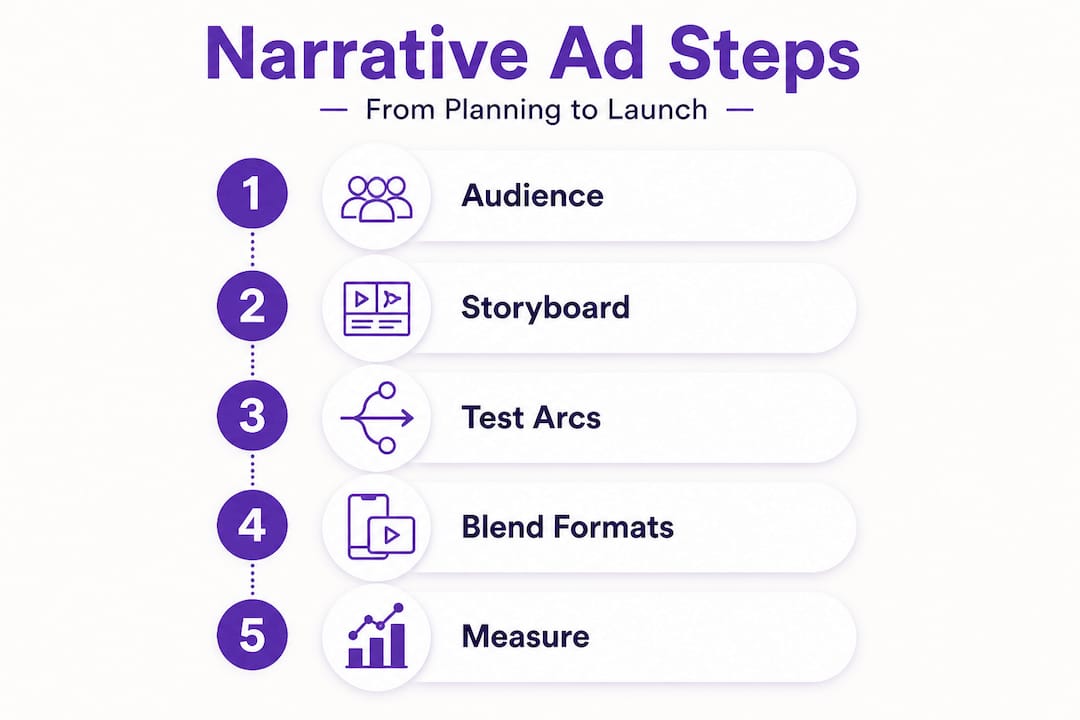
Step 3: Testing multiple arcs. Do not launch with a single narrative. Create two or three distinct story angles and test them simultaneously. One arc might feature a character under external threat. Another might feature an internal dilemma. A third might use humour to create a different kind of tension. The data will identify which emotional register resonates most with your specific audience.
Step 4: Blending video and playable. Where budget and format allow, combine a short video narrative introduction with a playable interactive segment. This hybrid approach leverages the measurable performance advantages of both formats.
Step 5: Iterating by install and retention data. Use IPM as your primary creative signal and D7 retention as your quality filter. A high-IPM, low-retention narrative is misleading players about the game’s actual experience. Align the story’s emotional promise with the game’s real tone and mechanics.
| Story element | User journey stage | Objective |
|---|---|---|
| Setup and character | Awareness | Immediate identification |
| Conflict and stakes | Consideration | Emotional investment |
| Interactive choice | Intent | Agency and engagement |
| Partial resolution | Decision | Motivation to install |
| Post-install experience | Retention | Expectation alignment |
Review playable ad best practices before finalising your creative brief, and explore video to playable ad tools that can accelerate your hybrid production workflow significantly.
Pro Tip: Avoid three common pitfalls. Overcomplexity kills short-form narrative. Over-branding breaks the player-as-protagonist frame. Poor measurement (optimising for CTR rather than IPM and D7 retention) creates the illusion of performance without delivering actual business outcomes.
Why most mobile ads get narrative wrong and what actually works
A practical toolset is now in place, but it is worth questioning the default approaches and exposing the nuances that most marketers overlook.
The marketing industry has absorbed the message that storytelling matters. The response, unfortunately, has often been to add surface-level story elements to existing ad formats without rethinking the fundamental structure. A character is dropped in. A vaguely dramatic soundtrack is added. The brand logo appears prominently throughout. The result is an ad that gestures at narrative without achieving it. These executions frequently underperform because they miss the core psychological mechanism entirely.
The most common failure is brand-as-hero positioning. When the narrative centres on the game’s achievements, the developer’s legacy, or the product’s features, the user remains emotionally external to the story. They are watching someone else’s triumph. This is the opposite of what drives installation behaviour. Avoiding brand-as-hero framing and measuring IPM and D7 retention over CTR alone are the two adjustments that separate high-performing narrative campaigns from mediocre ones.
The second failure is conflating emotional surface with emotional depth. An ad can feature a sad character, a triumphant moment, or a comedic scenario and still generate zero emotional investment if the structure lacks genuine tension and earned resolution. Emotion without stakes is decoration. Emotion with stakes is story.
The third failure is chasing click-through rate as the headline metric for narrative performance. CTR measures whether an ad attracted attention. It does not measure whether the story created genuine intent to install or whether the user’s experience of the ad aligned with their subsequent experience of the game. For user acquisition managers serious about long-term campaign performance, exploring creative UA ad concepts that are built around retention-aligned narratives is a more disciplined approach than optimising for the cheapest click.
What actually works is structural commitment. A six-second ad with a genuine problem, a real choice, and an honest resolution consistently outperforms a thirty-second ad that wraps promotional content in decorative story trappings. The format is secondary. The architecture is what matters.
Get started with cost-effective narrative playable ads
Having understood both the pitfalls and the winning approaches, you are now ready to put narrative into action with the right tools behind you.
At PlayableMaker, we have built a no-code platform designed specifically for user acquisition teams who need to create high-quality, narrative-driven playable ads without consuming developer resources or exceeding creative budgets. The psychology behind effective playable ads is already built into our framework. Whether you are exploring how playable ads are revolutionising digital engagement or looking for practical guidance on cost-effective ad creation for your mobile game, PlayableMaker gives you the tools to move from brief to live creative, quickly and without technical complexity.
Frequently asked questions
How can narrative advertising improve mobile game user acquisition?
Narrative ads drive emotional engagement and higher retention, making users more likely to install and remain with your mobile game because the storytelling drives memory retention in a way that feature lists simply cannot replicate.
What’s the difference between narrative and traditional playable ads?
Narrative playables incorporate a story with protagonists, conflict, and resolution, while traditional playables often focus solely on game mechanics or features. The emotional connection created by story elements is what drives the performance difference between the two formats.
How short can a narrative in playable advertising be?
Effective narrative arcs can be delivered in as little as six seconds, provided they include clear tension and a problem-resolution arc that the player can experience within the compressed format.
Should the brand or the user be the protagonist in a narrative ad?
The user should always be the hero. Customer-as-protagonist framing creates immediate personal investment, whereas brand-as-hero positioning leaves users emotionally disengaged and reduces both install rates and downstream retention.
Recommended
- Role of Storytelling in Ads: Elevating User Acquisition – playablemaker.com Role of Storytelling in Ads: Elevating User Acquisition
- 7 Best Examples of Mobile Game Ads and Why They Work – playablemaker.com 7 Best Examples of Mobile Game Ads and Why They Work
- 7 Creative Ad Concepts for Mobile Game User Acquisition – playablemaker.com 7 Creative Ad Concepts for Mobile Game User Acquisition
- Top mobile ad platforms for gaming user acquisition – playablemaker.com Top mobile ad platforms for gaming user acquisition
- UGC Creators for Mobile Apps – Collab Only
- Ad creative best practices that actually lift ROAS