
Playable ads are reshaping how mobile games acquire users, yet many marketing teams still treat them as an expensive luxury reserved for studios with deep pockets and dedicated engineering teams. That assumption is worth questioning. Interactive mini-games that let users try core gameplay mechanics before installing, typically running 15 to 30 seconds, consistently outperform passive formats on engagement and install quality. The real barrier is not budget or technical complexity. It is knowing how the mobile ad ecosystem works, what makes a playable ad perform, and how to iterate quickly without burning resources. This guide addresses all three.
Table of Contents
- Understanding mobile ad ecosystems and playable ads
- Key elements for designing high-performance playable ads
- Optimisation strategies: testing, analytics, and scaling success
- Industry examples and frameworks for actionable implementation
- A new mindset for winning in mobile ad ecosystems
- Effortless playable ad creation with PlayableMaker
- Frequently asked questions
Key Takeaways
| Point | Details |
|---|---|
| Playable ads drive engagement | Interactive playable ads outperform passive ads by letting users try core gameplay, boosting installs and retention. |
| No-code platforms speed creation | User acquisition teams can launch effective campaigns fast using drag-and-drop tools without coding skills. |
| Iterative testing delivers results | Optimising a single variable in each test and tracking engagement ensures high-quality, scalable campaigns. |
| Simplicity is key | The best performing playable ads focus on 1-2 core game mechanics for clarity and faster loading. |
Understanding mobile ad ecosystems and playable ads
The mobile ad ecosystem involves several interconnected players, each with a distinct role. Advertisers, such as game studios and UA teams, want to reach high-quality users at efficient cost. Ad networks act as intermediaries, connecting advertisers to publishers (apps and games where ads are displayed). Demand-side platforms, known as DSPs, allow advertisers to bid for ad inventory programmatically. Supply-side platforms, or SSPs, help publishers manage and sell that inventory. Understanding where your ad sits within this chain matters because it affects targeting precision, cost, and creative requirements.
Within this ecosystem, ad formats vary considerably. Standard banner ads offer low engagement. Video ads improve attention but remain passive. Interstitials interrupt the user experience, which can frustrate rather than convert. Playable ads occupy a different category entirely. They invite participation rather than observation, which fundamentally changes player expectations and, consequently, install intent.
A well-structured playable ad follows a clear three-part format: a lead-in video, interactive core, and call-to-action. The lead-in grabs attention within the first two seconds. The interactive core lets the user experience one or two gameplay mechanics directly. The call-to-action converts that engagement into an install. Each element must serve the next.
Key differences between common mobile ad formats:
| Format | User interaction | Typical engagement | Install quality |
|---|---|---|---|
| Banner | None | Very low | Low |
| Video/interstitial | None | Moderate | Moderate |
| Playable ad | High | High | High |
Playable ads can be distributed across major creative ad formats within ad networks including Meta Audience Network, Google UAC, and ironSource. Placement matters. Rewarded placements, where users opt in to watch or interact in exchange for in-game currency, tend to attract more motivated users and produce stronger downstream metrics.
- Playable ads generate higher-intent installs because users self-select after experiencing the game
- They reduce post-install churn by setting accurate expectations before the download
- Interactive formats typically produce stronger retention at day 1 and day 7 compared to passive equivalents
- They perform particularly well in rewarded and interstitial placements within casual and mid-core games
Key elements for designing high-performance playable ads
Having explored the ecosystem and ad types, it is time to identify what actually goes into designing playable ads that deliver measurable results.
The most common mistake UA teams make is overcomplicating the experience. A playable ad is not a demo. It is a distilled, emotionally immediate version of your game’s core appeal. Simplicity is a feature, not a compromise. Aim for one or two core loops at most. If a user needs more than three seconds to understand what to do, the mechanic is too complex for the format.

No-code creation tools have made this process significantly more accessible. Rather than tasking developers with building custom HTML5 ads from scratch, no-code platforms allow marketing teams to design, test, and publish playable ads without writing a single line of code. This shifts ownership of the creative process back to the people who understand campaign goals best.
Technical compliance is non-negotiable. MRAID (Mobile Rich Media Ad Interface Definitions) is the industry standard protocol that ensures your playable ad communicates correctly with the host app’s ad container. Ads that are not MRAID-compliant may fail to render or behave unpredictably across networks. Load speed is equally critical. Rapid creation best practices recommend keeping load time under 1.2 seconds, simplifying to one or two core loops, and using no-code platforms for speed.
“The best playable ads feel effortless to the user and ruthlessly efficient to the marketer. Every second of interaction should be earning its place.”
A structured approach to playable ad design:
- Define the single core mechanic you want users to experience
- Build the lead-in video to contextualise that mechanic in under three seconds
- Design the interactive core for immediate comprehension, no tutorial required
- Place a clear, visually prominent call-to-action at the moment of peak engagement
- Test on multiple device sizes before publishing to any network
- Validate MRAID compliance and confirm load speed meets the 1.2-second threshold
Pro Tip: Prioritise engagement over clicks. A user who plays for eight seconds and then installs is far more valuable than one who taps the CTA immediately without engaging. Design the experience to earn that install, not rush it.
Optimisation strategies: testing, analytics, and scaling success
Equipped with design knowledge, the next frontier is continuous improvement, making playable ads outperform through rigorous testing and smart analytics.
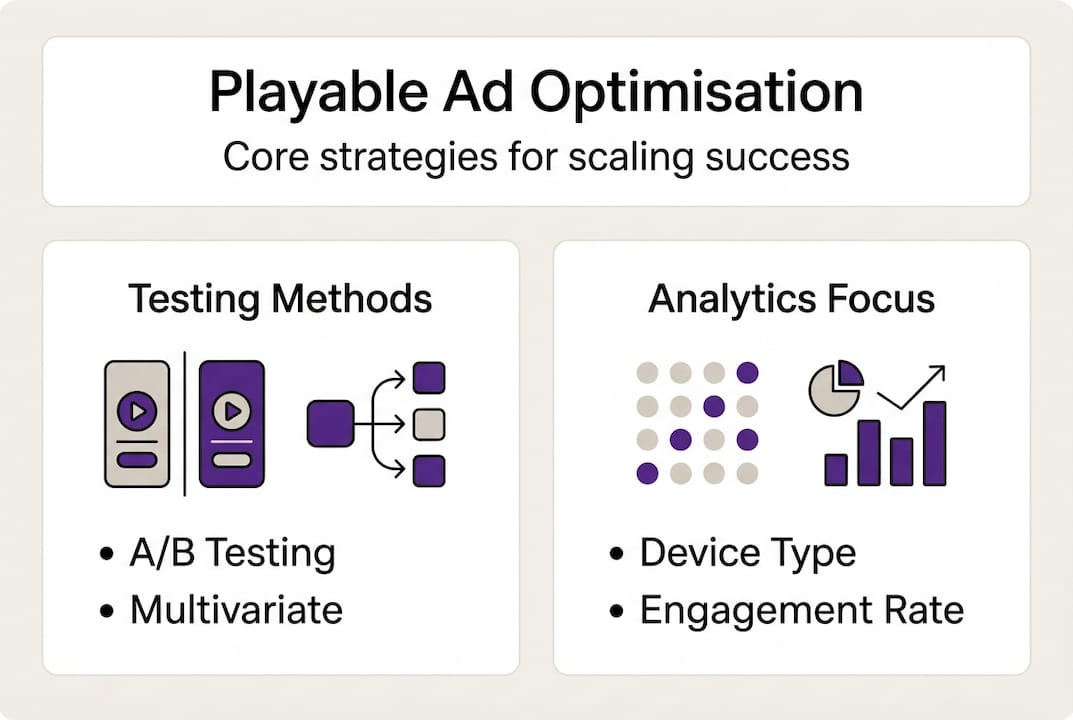
A/B testing is the backbone of any serious optimisation programme. The key discipline is isolating one variable per test. Changing the lead-in video, the core mechanic, and the CTA colour simultaneously makes it impossible to attribute performance differences to any single element. Run clean tests. A/B testing for playable ads works best when each experiment has a clear hypothesis and a defined success metric before launch.
Comparing optimisation approaches:
| Approach | Speed | Insight quality | Resource cost |
|---|---|---|---|
| Multivariate testing | Fast | Difficult to isolate | High |
| Single-variable A/B | Moderate | Clear and actionable | Low |
| Geo/device segmentation | Slow | Highly specific | Moderate |
The metrics that matter most in playable ad campaigns are IPM (Installs per Mille, meaning installs per thousand impressions), engagement rate, and completion rate. IPM tells you how efficiently your ad converts impressions into installs. Engagement rate reveals whether users are actually interacting with the core mechanic. Completion rate shows how many users reach the CTA. Together, these three metrics give you a reliable picture of where the ad is working and where it is losing users.
Effective optimisation follows a clear sequence: A/B test one variable, optimise for IPM, engagement, and completion rate, then launch small before scaling. The A/B testing guide reinforces this with a practical framework: ideate the core mechanic, prototype rapidly, test single variables, segment results by geography and device type, and consistently prioritise engagement signals over surface-level click data.
- Launch with a limited budget pilot across one or two networks
- Run for enough impressions to reach statistical significance (typically 5,000 to 10,000 impressions per variant)
- Identify the winning variant based on IPM and engagement rate
- Scale the winner while pausing underperformers
- Introduce the next variable test on the scaled winner
Pro Tip: Segment your results by device type early. A playable ad that performs well on iOS may underperform on Android due to differences in rendering, screen size, and user behaviour. The essential A/B test steps for mobile consistently show that device segmentation uncovers performance gaps invisible in aggregate data.
Industry examples and frameworks for actionable implementation
All strategies become more powerful when paired with practical insights from real-world campaigns. Let us see how theory meets reality.
Consider a mid-size casual puzzle game studio running user acquisition across Meta and ironSource. Their initial video interstitial campaign produced acceptable CPIs but poor day-7 retention. After switching to a playable ad featuring a single puzzle mechanic, their day-7 retention improved noticeably because users who installed already understood and enjoyed the core loop. The successful playable ad examples from comparable studios consistently show this pattern: higher install quality, lower churn, better lifetime value.
For resource-constrained teams, a rapid implementation framework helps avoid paralysis:
- Week 1: Identify the single mechanic that best represents your game’s appeal
- Week 2: Build and QA one playable ad variant using a no-code platform
- Week 3: Launch a small pilot, collect IPM and engagement data
- Week 4: Iterate based on data, introduce one new variable for the next test
“Speed of learning beats perfection of execution. A good playable ad launched this week outperforms a perfect one launched next quarter.”
Common pitfalls to avoid include overcomplicating the mechanic, neglecting load speed, and failing to align the ad experience with the actual in-game experience. Misleading playable ads may drive installs but produce terrible retention, which ultimately damages your campaign economics.
Repurposing creatives is an underused efficiency lever. Assets built for one campaign, character animations, UI elements, sound effects, can often be adapted for new playable ad variants at a fraction of the original production cost.
Hybrid monetisation combining in-app advertising (IAA) and in-app purchases (IAP) pairs particularly well with playable ads. Users acquired through interactive formats tend to engage more deeply, making them more likely to both watch rewarded ads and make purchases.
Pro Tip: Build your playable ad library incrementally. Each new variant you create is a reusable asset. Over time, you accumulate a portfolio of tested creatives that can be remixed and redeployed across new campaigns with minimal additional cost.
A new mindset for winning in mobile ad ecosystems
Armed with best practices and frameworks, it is worth challenging one assumption that quietly undermines many UA teams: the belief that more data automatically leads to better decisions.
In practice, teams that obsess over data collection often move slower than teams that run rapid experiments and act on directional signals. The mobile ad ecosystem rewards speed of learning, not volume of analysis. A minimum viable playable ad, built in days rather than weeks, launched with a modest budget, and iterated based on real performance data, will consistently outperform a heavily engineered creative that took months to produce.
The psychology behind playable ads supports this view. Users respond to immediacy and relevance. An ad that feels slightly rough but genuinely fun will outperform a polished ad that fails to engage. Efficiency in this context means learning faster from smaller failures, not eliminating failure altogether. Redefine what a successful campaign looks like: not a single perfect creative, but a system of rapid iteration that compounds improvements over time.
Effortless playable ad creation with PlayableMaker
If this guide has clarified the opportunity, PlayableMaker is where that clarity becomes action. The platform is built specifically for UA specialists and marketing managers who need to create, test, and deploy playable ads without depending on developers or stretching budgets. No-code tools mean your team retains creative control from concept to launch. Iterative testing is built into the workflow, so you can act on the optimisation strategies covered here immediately. Explore the benefits for marketers in detail, or review platform pricing to find the right plan for your team’s scale and ambitions.
Frequently asked questions
What is a mobile ad ecosystem?
A mobile ad ecosystem is the network of publishers, ad networks, DSPs, SSPs, and advertisers working together to deliver targeted ads to mobile users. Each player in the chain affects how your ad is served, priced, and measured.
How do playable ads differ from standard video or interstitial ads?
Unlike video or interstitials, playable ads let users interact with a short game experience before deciding to install. Structured into lead-in, interactive core, and CTA, they generate higher-intent installs by letting users self-select.
Which metrics are critical for optimising playable ad campaigns?
IPM, engagement rate, and completion rate are the most reliable indicators of playable ad performance, revealing how efficiently an ad converts impressions, engages users, and drives installs.
Do I need to code to create playable ads?
No-code platforms such as PlayableMaker enable marketing teams to build and publish playable ads without any programming skills, significantly reducing both production time and cost.
Recommended
- 7 Essential Types of In-Game Ads for Mobile App Success – playablemaker.com 7 Essential Types of In-Game Ads for Mobile App Success
- 7 Best Examples of Mobile Game Ads and Why They Work – playablemaker.com 7 Best Examples of Mobile Game Ads and Why They Work
- Master Mobile Ad Trend Analysis 2025 for Playable Ads Success – playablemaker.com Master Mobile Ad Trend Analysis 2025 for Playable Ads Success
- What Two Main Ad Formats Can Be Used in Mobile Gaming? – playablemaker.com What Two Main Ad Formats Can Be Used in Mobile Gaming?
- Effective Online Advertising Tips for Small Businesses 2025 | Ibrandmedia