Finding affordable ways to create engaging ad experiences is a constant challenge for every user acquisition specialist at mobile gaming startups from London to Seoul. With marketing budgets tight and technical resources scarce, solutions that simplify the process are needed now more than ever. No-code HTML5 playable ads deliver interactive, hands-on previews of your game without the need for a development team, raising user engagement while keeping costs down.
Table of Contents
- What Are HTML5 Ads And Why They Matter
- Key Formats: Static, Interactive, Playable
- How HTML5 Ads Work In Practice
- Benefits Of No-Code Playable Ad Creation
- Cost, Common Pitfalls, And Best Practices
Key Takeaways
| Point | Details |
|---|---|
| HTML5 Ads Enhance Engagement | HTML5 ads allow for rich, interactive experiences that capture user attention more effectively than traditional formats. |
| Diverse Ad Formats Offer Flexibility | Marketers can choose from static, interactive, and playable ads to cater to different engagement levels and objectives. |
| No-Code Solutions Democratise Ad Creation | No-code platforms enable rapid development of interactive ads, empowering marketers without technical expertise. |
| Technical Precision Is Crucial | Understanding technical specifications and implementing best practices ensure optimal performance and user experience across devices. |
What Are HTML5 Ads And Why They Matter
HTML5 ads represent a revolutionary approach to digital advertising that enables rich, interactive experiences across multiple devices and platforms. These versatile advertising assets are constructed using web technologies like HTML, CSS, and JavaScript, allowing for dynamic and engaging content delivery.
Unlike traditional static advertisements, HTML5 ads provide marketers with unprecedented flexibility. Rich media capabilities enable advertisers to incorporate videos, animations, and interactive elements that capture user attention far more effectively than conventional banner ads. They seamlessly adapt to different screen sizes and resolutions, ensuring a consistent user experience whether viewed on smartphones, tablets, or desktop computers.
Key advantages of HTML5 ads include:
- Compatibility across multiple browsers and devices
- Support for advanced interactive features
- Smaller file sizes compared to traditional rich media formats
- Detailed performance tracking and analytics
- No requirement for specialised coding skills
The technological evolution has positioned HTML5 ads as a superior alternative to older technologies like Flash, which suffered from significant security vulnerabilities and limited mobile compatibility. Modern platforms now enable marketers to create sophisticated, responsive advertisements without extensive technical expertise.
Pro tip: When designing HTML5 ads, focus on creating concise, engaging experiences that provide immediate value to potential users.
Key Formats: Static, Interactive, Playable
HTML5 advertising has evolved dramatically, presenting marketers with three distinct ad formats that offer progressively sophisticated user engagement strategies. Each format represents a unique approach to capturing audience attention and driving conversions in the digital marketplace.
The first format, static ads, represents the most basic form of digital advertising. These straightforward display advertisements typically feature fixed images or graphics with minimal interactivity. While cost-effective and simple to produce, static ads often struggle to maintain user engagement in an increasingly dynamic digital landscape.
Interactive ads introduce a layer of user participation, enabling audiences to engage beyond passive viewing. These advertisements might include elements like:
- Clickable hotspots
- Simple games or challenges
- Animated transitions
- User-controlled exploration
- Personalisation features
Playable ads represent the pinnacle of interactive advertising, providing immersive preview experiences that allow users to sample an app or game directly within the advertisement. These sophisticated formats typically last between 10-25 seconds and conclude with a clear call-to-action, dramatically increasing user engagement and conversion potential.
Playable ads can increase conversion rates by up to 300% compared to traditional static advertisements.
By offering potential users a direct, hands-on interaction with the product, playable ads create a more compelling and memorable advertising experience. They bridge the gap between traditional marketing and actual product experience, giving users a genuine taste of what they might purchase.
Here’s how the main HTML5 ad formats compare in approach and user engagement:
| Ad Format | User Interaction Level | Typical Duration | Ideal Use Case |
|---|---|---|---|
| Static | Passive viewing | 3-7 seconds | Branding, broad reach |
| Interactive | Moderate participation | 7-15 seconds | Engagement, product awareness |
| Playable | Highly immersive | 10-25 seconds | App/game demos, high conversion |
Pro tip: Design playable ads that provide genuine value and a realistic preview of your product’s core experience in under 20 seconds.
How HTML5 Ads Work In Practice
HTML5 advertisements represent sophisticated digital experiences that transform traditional advertising into interactive, dynamic content. Unlike static banner ads, these advanced formats leverage web technologies to create engaging, responsive marketing assets that capture user attention instantly.

Lightweight web page experiences form the core of HTML5 ad functionality, combining three critical technologies: HTML, CSS, and JavaScript. These components work together to create ads that are both visually appealing and functionally dynamic, enabling complex interactions within a compact digital space.
Key technical components of HTML5 ads include:
- Responsive design adapting to different screen sizes
- Dynamic content rendering
- Interactive elements and animations
- Embedded multimedia capabilities
- Performance tracking mechanisms
The technical architecture of HTML5 ads allows for remarkable flexibility. Advertisers can incorporate various interactive elements such as:
- Clickable buttons and hotspots
- Mini-games and product demonstrations
- Animated transitions
- Video and audio integration
- Real-time personalisation features
HTML5 ads transform digital advertising from passive viewing to an immersive, interactive experience.
Unlike traditional advertising formats, HTML5 ads provide granular performance tracking, enabling marketers to understand user interactions at a microscopic level. Each click, hover, and interaction can be measured, providing unprecedented insights into user engagement and ad effectiveness.
Pro tip: Prioritise creating HTML5 ads with clear, intuitive interactions that provide immediate value to potential users.
Benefits Of No-Code Playable Ad Creation
No-code playable ad platforms are transforming digital marketing by democratising interactive advertising creation, enabling teams without deep technical expertise to produce sophisticated, engaging ad experiences. These innovative tools break down traditional barriers that previously limited advanced ad production to specialist development teams.
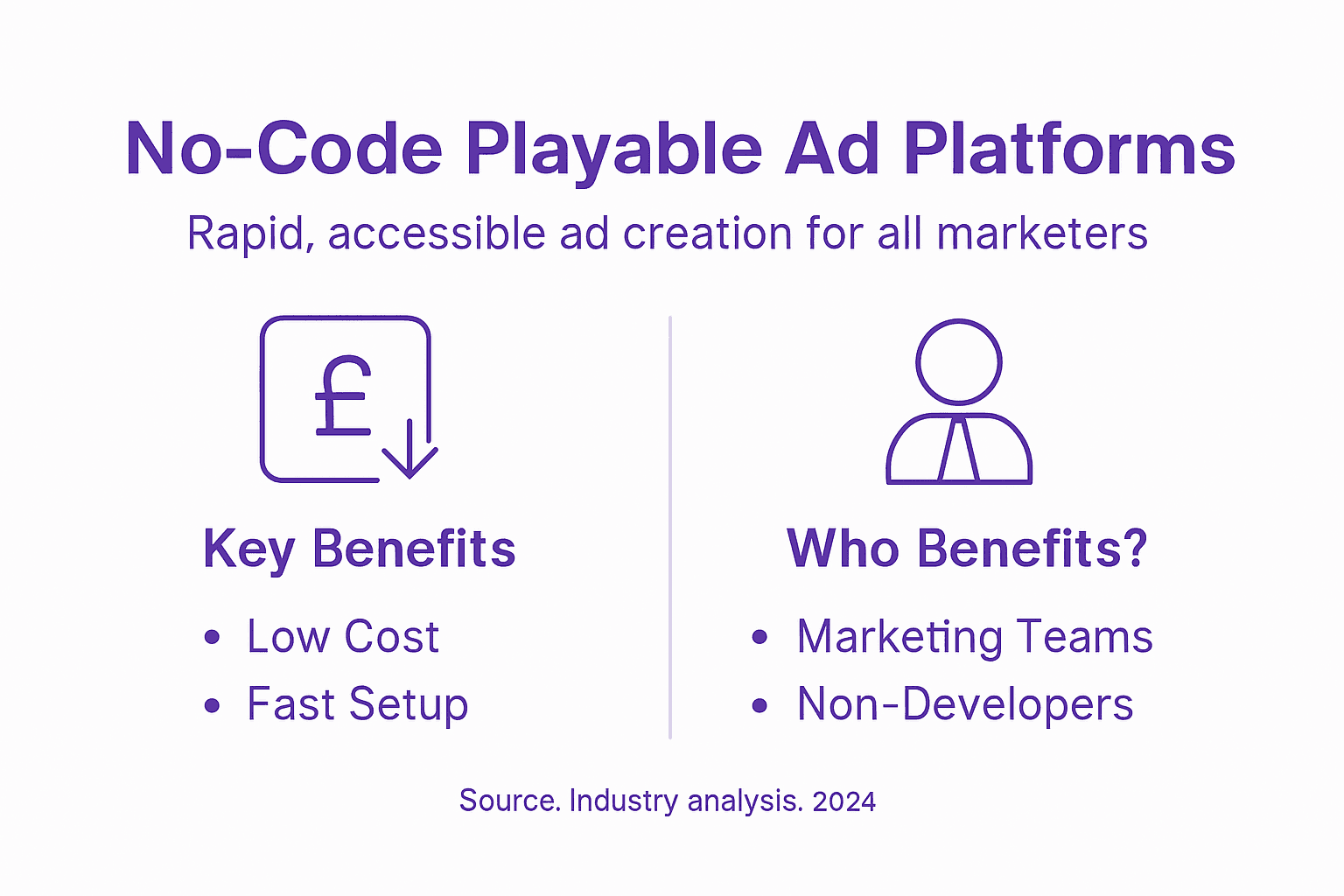
No-code tools are accelerating interactive ad adoption across multiple industries, providing marketers with unprecedented creative flexibility. By removing complex coding requirements, these platforms empower creative professionals to design, test, and optimise interactive advertisements rapidly.
Key benefits of no-code playable ad creation include:
- Reduced dependency on engineering resources
- Faster campaign deployment
- Lower production costs
- Enhanced creative experimentation
- Simplified workflow processes
- Rapid iteration and testing
The democratisation of ad creation enables organisations to:
- Explore innovative marketing strategies
- Develop more personalised advertising experiences
- Reduce time-to-market for new campaigns
- Decrease reliance on specialised technical teams
- Increase overall marketing agility
No-code platforms represent a paradigm shift in digital advertising, transforming creative possibilities for marketing teams.
By eliminating technical barriers, these platforms enable marketing teams across various sectors—from gaming and retail to finance and technology—to create rich, interactive content that drives user engagement and potential conversions.
Pro tip: Start with simple interactive templates and progressively build complexity as you become more comfortable with no-code playable ad creation tools.
Cost, Common Pitfalls, And Best Practices
Navigating the landscape of HTML5 advertising requires a strategic approach that balances creative ambition with technical constraints. Marketers must understand the nuanced challenges and opportunities presented by interactive digital advertising formats to maximise their campaign effectiveness.
Technical specifications play a critical role in ensuring successful HTML5 ad performance across diverse digital platforms. Understanding file size limitations, animation duration, and responsive design requirements becomes paramount for creating compelling and functional interactive advertisements.
Common cost considerations and challenges include:
- Initial platform and design tool investments
- Technical resource allocation
- Performance tracking and analytics expenses
- Content creation and iteration costs
- Potential render failures on different devices
- Ongoing optimisation requirements
Key best practices for HTML5 ad creation involve:
- Maintaining compact file sizes
- Designing for multiple device compatibility
- Creating backup static image versions
- Implementing precise targeting strategies
- Conducting regular performance testing
- Ensuring smooth, non-intrusive animations
Successful HTML5 ads balance technical precision with creative storytelling, transforming potential limitations into engagement opportunities.
Marketers must also develop robust contingency strategies, such as providing backup static image alternatives to prevent complete ad failure when interactive content cannot render. These fallback mechanisms ensure consistent brand visibility across varied technological environments.
This table summarises common pitfalls and effective solutions for HTML5 advertising campaigns:
| Challenge | Impact | Solution |
|---|---|---|
| Large file size | Slow load, user frustration | Optimise assets |
| Mobile incompatibility | Poor user experience | Design mobile-first |
| Animation overload | Distracts from main message | Use subtle effects |
| Render failures | Missed impressions, lost revenue | Provide static fallback |
Pro tip: Always design your HTML5 ads with a ‘mobile-first’ approach, prioritising performance and user experience on smaller screens.
Streamline Your HTML5 Playable Ads with No-Code Solutions
Creating engaging HTML5 playable ads as described in the article often comes with significant challenges such as high costs, reliance on developer resources, and complex technical demands. These pain points can slow down your marketing efforts and drain your budget while you strive to build interactive ads that truly captivate users. The article highlights how no-code tools are revolutionising ad creation by enabling faster deployment and easier iteration — exactly where PlayableMaker excels.
PlayableMaker offers a fast, budget-friendly way to build playable and interactive ads without sacrificing quality or technical expertise. Our no-code platform removes the need for specialised developers so your team can deliver immersive HTML5 ads quickly while maintaining excellent performance and user engagement. To explore best practices and guidance on publishing your interactive ads effectively, visit our Publishing Archives. For support and tips on maximising your playable ad campaigns consult our Help Archives.
Ready to transform your HTML5 ad strategy with easy no-code creation? Discover how PlayableMaker makes interactive advertising accessible to everyone by visiting PlayableMaker today and start building ads that convert faster and cost less.
Frequently Asked Questions
What are HTML5 ads?
HTML5 ads are interactive digital advertisements created using modern web technologies like HTML, CSS, and JavaScript, offering dynamic content delivery across various devices and platforms.
How do HTML5 ads compare to traditional static ads?
Unlike traditional static ads, HTML5 ads allow for rich media integration, such as videos and animations, providing a more engaging user experience and higher conversion potential due to their interactive nature.
What are the main formats of HTML5 ads?
The main formats include static ads, which are simple and non-interactive; interactive ads, which encourage user participation; and playable ads, which offer immersive experiences allowing users to interact directly with an app or game within the ad.
How can no-code platforms benefit HTML5 ad creation?
No-code platforms enable marketers without extensive technical expertise to easily create and optimise interactive ads, accelerating campaign deployment, reducing costs, and enhancing creative experimentation.
Recommended
- Integrating Playable Ads into Your Marketing Strategy – playablemaker.com Integrating Playable Ads into Your Marketing Strategy
- Playable Ads Explained: Revolutionizing Digital Engagement – playablemaker.com Playable Ads Explained: Revolutionizing Digital Engagement
- Comparing Playable Ads to Other Ad Formats: What You Need to Know – playablemaker.com Comparing Playable Ads to Other Ad Formats: What You Need to Know
- Best Practices for Playable Ads: Insights and Strategies – playablemaker.com Best Practices for Playable Ads: Insights and Strategies