
TL;DR:
- Creating viral playable ads no longer requires extensive developer resources thanks to no-code platforms that enable rapid, cost-effective production. Successful viral ads focus on emotional resonance, mechanical simplicity, and natural calls-to-action, which increase user engagement and sharing potential. Implementing disciplined, iterative processes and fostering a creative culture are essential for sustained success in producing breakout ad content.
Most mobile gaming marketers assume that creating viral playable ads means months of developer time, five-figure budgets, and painful back-and-forth with engineering teams. That assumption is costing them both time and competitive advantage. No-code platforms have fundamentally changed the production equation, allowing marketing teams to build, test, and launch interactive ad content in a fraction of the traditional time and at a fraction of the cost. This guide lays out practical frameworks, honest cost-saving tactics, and proven creative principles to help you produce playable ads that genuinely spread, without touching a single line of code.
Table of Contents
- What makes playable ads go viral?
- How no-code solutions enable rapid ad creation
- Core frameworks for building viral ad content
- Cost-effective tips and common pitfalls to avoid
- Behind the scenes: what most marketers miss about viral ad content
- Start building viral playable ads, no code required
- Frequently asked questions
Key Takeaways
| Point | Details |
|---|---|
| No-code accelerates ad creation | You can build and launch viral playable ads rapidly and affordably with modern no-code platforms. |
| Virality requires user-centric design | Simple, fun, shareable mechanics make playable ads perform and spread. |
| Framework and testing beat luck | Systematic creative processes and feedback loops consistently produce winning ads. |
| Avoid overspending with smart tools | No-code solutions and early testing keep budgets lean without sacrificing impact. |
What makes playable ads go viral?
With the scene set, let’s clarify what separates successful, viral playable ads from forgettable ones.
Virality is not random. In the context of playable ads, it is a measurable outcome driven by specific design and psychological decisions. Understanding these decisions is the first step towards producing content that users want to engage with and, crucially, share.
The core drivers of viral playable ad performance break down into three categories: emotional resonance, mechanical simplicity, and a clear call-to-action. Emotional resonance means the user feels something within the first five seconds, whether that is curiosity, competitive drive, or the satisfaction of a quick win. Mechanical simplicity means the mini-game is so intuitive that no instructions are needed. The call-to-action must follow naturally from the experience rather than interrupt it.
Playable ads engage users longer and drive more conversions than static or video-only formats. This is not merely a creative preference but a structural advantage: when users actively participate rather than passively watch, their cognitive investment in the experience increases significantly. That investment translates directly into better recall, stronger intent signals, and higher conversion rates.
Compare the two most common interactive formats:
| Format | Average engagement time | User intent signal | Shareability |
|---|---|---|---|
| Video ad | 15 to 30 seconds (passive) | Low to medium | Low |
| Playable ad | 30 to 75 seconds (active) | Medium to high | High |
| Hybrid (video + playable) | 45 to 90 seconds | High | Medium to high |
When you look at these figures alongside video vs playable ads performance data from live campaigns, the pattern is consistent. Active formats consistently outperform passive ones on the metrics that matter most to user acquisition teams.
Key characteristics shared by viral playable ads include:
- Instant gratification: The user experiences a micro-win or satisfying interaction within the first three seconds.
- Clear mechanic: One or two simple interactions, never more. Tap, swipe, drag. Nothing that requires a tutorial.
- Emotional loop: The experience builds mild tension and releases it, creating a satisfying arc even in 30 seconds.
- Visible progress: Users see their actions having an effect in real time, reinforcing the desire to continue.
- Frictionless sharing prompt: The call-to-action appears at the moment of peak engagement, not as an afterthought.
Balancing these elements is an iterative process. No single formula produces virality every time. But marketers who understand these drivers can test towards it systematically rather than hoping for luck.
How no-code solutions enable rapid ad creation
Now you know why playables go viral, so let’s see how anyone can build them fast with modern no-code tools.
The traditional route to a playable ad involved briefing developers, waiting for a build, reviewing, revising, and repeating. A single ad could take four to six weeks. No-code development has compressed that cycle dramatically. No-code development significantly reduces cost and time for engaging mobile game ads, making it accessible to marketing teams without specialist technical knowledge.
Modern no-code platforms offer drag-and-drop interfaces, pre-built templates for common mobile game genres, and visual logic builders that replace code with intuitive condition settings. A marketer familiar with design tools can produce a fully functional playable ad in hours rather than weeks.

Here is a straightforward comparison of traditional versus no-code production timelines:
| Stage | Traditional dev cycle | No-code platform |
|---|---|---|
| Initial concept to prototype | 2 to 3 weeks | 2 to 4 hours |
| First round of revisions | 1 week | 30 to 60 minutes |
| Testing and QA | 3 to 5 days | Same day |
| Launch-ready asset | 4 to 6 weeks total | 1 to 3 days total |
The numbers above reflect a consistent pattern across marketing teams that have made the switch. The speed advantage alone justifies the transition, but the cost savings are equally significant. When you remove developer hours from the equation, the per-asset cost drops sharply, allowing for more iterations and more variants to test.
The step-by-step process for building your first playable ad on a no-code platform typically looks like this:
- Choose a genre-appropriate template. Most platforms offer templates for hyper-casual, puzzle, RPG, and action game formats. Start with one that matches your game’s core loop.
- Customise the visual assets. Upload your game’s characters, backgrounds, and UI elements to align the ad with your brand identity.
- Set the interaction logic. Use visual condition builders to define what happens when a user taps, swipes, or completes an action.
- Add a reward or progression moment. Programme in a micro-win that occurs before the call-to-action appears.
- Configure the end card. Design a clear, compelling call-to-action that feels like a natural next step from the gameplay experience.
- Export and test on device. Most platforms allow direct export to standard ad network formats, ready for immediate testing.
Using a video editor for playable ads can also accelerate the process by converting existing video creative into interactive formats, reducing the need to build entirely from scratch.
Pro Tip: Before building from a blank template, browse top mobile ad examples in your genre. Reverse-engineer what makes the best ones work before you start designing your own.
Core frameworks for building viral ad content
With no-code tools, process trumps luck. Here is the framework for maximising the viral factor.
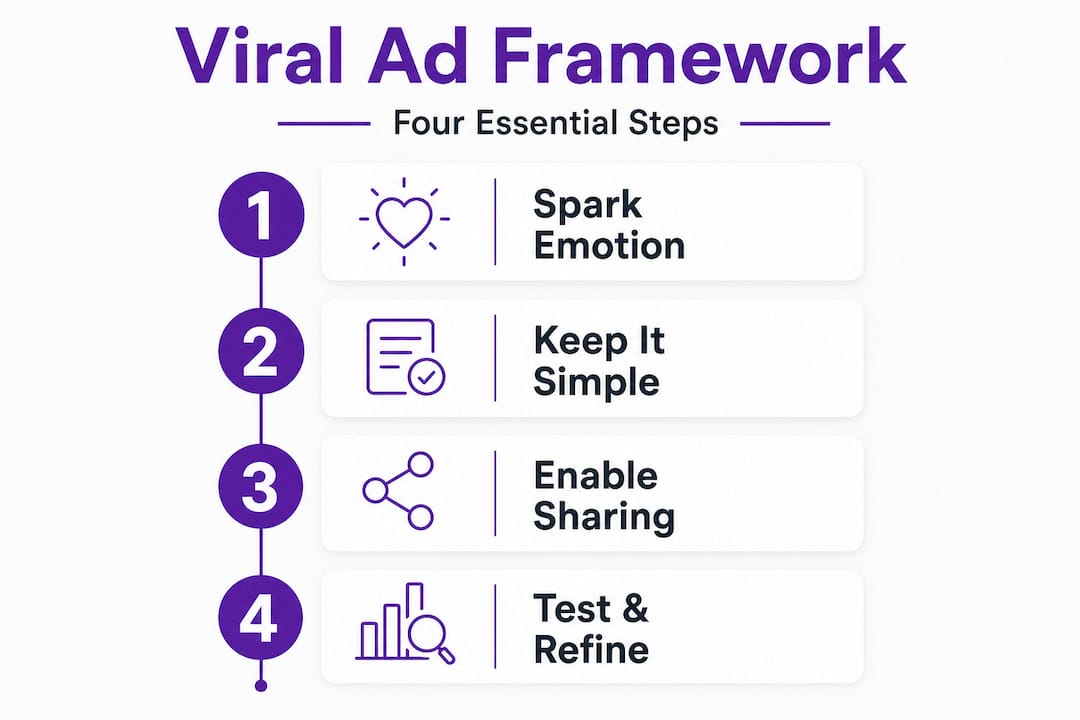
A reliable creative process is what separates teams that produce one breakout ad from teams that produce them consistently. Effective ad creative processes involve rapid prototyping, testing, and data-driven iteration. That principle should sit at the heart of every campaign you build.
Here is a practical four-stage framework for building viral playable ad content:
-
Define your audience and emotional triggers. Before opening any tool, clarify who you are targeting and what emotion you want them to feel. Are they competitive players who respond to challenge and mastery? Casual users who want relaxation and quick wins? Your mechanic and visual language should directly serve that emotional trigger.
-
Map out the mini-game logic. Keep it to one core interaction. Sketch the full user journey on paper first: what the user sees, what they do, what feedback they receive, and where the call-to-action appears. The journey should feel complete and satisfying in under 60 seconds.
-
Build and prototype rapidly. Use your no-code platform to produce a working prototype in the same day. It does not need to be visually polished at this stage. The goal is to test the core interaction for intuitiveness and engagement. Share it with three to five people outside your team and observe where they hesitate or disengage.
-
Iterate based on data, then scale. Run the prototype on a small paid audience, gathering interaction data. Which moment do users drop off? Where do they engage most intensely? Use that data to refine the experience before scaling spend. Use your ad performance checklist at each stage to ensure you are tracking the right signals.
“The best playable ads feel like the beginning of the game, not like an advertisement for it. That distinction is what drives genuine conversion.”
Drawing on video ad inspiration at the ideation stage can also help surface creative directions you might not have considered, particularly for teams working across multiple game genres simultaneously.
Embedding share mechanics from the outset, rather than adding them as an afterthought, is one of the most consistently overlooked steps. A share prompt that appears at the moment of peak emotional engagement, immediately after a user completes the mini-game challenge, significantly outperforms one that appears on a static end card.
Cost-effective tips and common pitfalls to avoid
Even with fast tools and strong frameworks, viral ad campaigns can stumble. Here is how to stay efficient and impactful.
Budget discipline in playable ad production is not just about keeping costs low. It is about ensuring that every pound spent generates reliable data and better creative decisions. Budgets for playable ad creatives can be tightly controlled with no-code tools and proper planning, provided you build cost awareness into your workflow from day one.
The most effective cost-saving tactics used by high-performing mobile gaming UA teams include:
- Start with templates, always. Custom builds are slower and more expensive. Templates encode best practices from hundreds of prior campaigns. Use them as your starting point, not your fallback.
- Test mechanics before testing aesthetics. Spend the first round of ad spend validating whether the core interaction is engaging. Polish the visuals only after the mechanic is proven. This saves both time and budget on iterations that may not matter.
- Cap your variant count per sprint. Running too many variants simultaneously dilutes your data. Test two to three variants at a time with clear hypotheses for each. More variants do not automatically produce better results.
- Set a cost-per-iteration budget ceiling. Before each round of changes, define the maximum spend for that test cycle. Without this discipline, iteration costs can accumulate quickly and obscure your return on investment.
- Avoid feature creep in your mechanic. The single most common mistake is adding more interactions in response to lukewarm initial data. More complexity rarely improves virality. Simplify instead.
Pro Tip: If an ad does not show promising engagement signals within the first 48 to 72 hours of a small-scale test, resist the urge to add features. Instead, go back to the emotional trigger. The mechanic may be fine, but the emotional hook may be misaligned with the audience.
Monitoring smart creative ad ideas from competitors and top-performing campaigns in your genre can help you identify patterns worth testing in your own creatives, without spending budget to discover what already works.
The most expensive mistake in playable ad production is not a technical one. It is a process one: teams that skip the small-scale validation phase and move directly from prototype to full campaign spend consistently report the highest wasted budgets and the lowest creative learning rates.
Behind the scenes: what most marketers miss about viral ad content
Practical steps are essential, but they only tell part of the story. The deeper question is: why do some teams consistently produce breakout ad content while others, using the same tools and similar budgets, rarely do?
The honest answer is that most marketers treat virality as though it were an outcome of a single great idea. It is not. It is the outcome of a disciplined creative culture. Teams that outperform on playable ads do not simply have better ideas. They have systems for generating, testing, and discarding ideas faster than anyone else.
Virality is a volume and velocity game, constrained by quality thresholds. A team that launches ten thoughtfully prototyped variants in the time it takes a competitor to launch two will, on average, produce more breakout performers. Not because of superior creativity alone, but because of superior iteration rate. The interactive ads workflow guide for mobile games makes this point clearly: process consistency is the hidden variable in creative performance.
There is also a cultural dimension that rarely surfaces in tactical guides. Organisations where marketers are genuinely encouraged to kill underperforming ads quickly, without political cost, consistently produce better creative output over time. The fear of admitting a variant failed leads to over-optimisation of poor ideas, which wastes budget and, more expensively, wastes time that could be spent on better directions.
The third element most teams miss is the feedback loop from users themselves. Social signals, in-ad interaction data, and even app store reviews after a campaign launches contain rich information about what resonated emotionally. Teams that build systematic processes for capturing and acting on this feedback create a compounding advantage. Each campaign teaches them something the next campaign benefits from. Teams that do not build this loop start each campaign from approximately the same knowledge base, regardless of how many campaigns they have run.
No-code tools remove the technical barrier. But the creative and cultural disciplines described above are what actually drive sustained performance. The tools give you speed. The discipline gives you compounding returns on that speed.
Start building viral playable ads, no code required
Ready to put these strategies into practice? The frameworks in this guide are designed to be applied immediately, not filed away for later. PlayableMaker brings together everything covered here into a single, accessible platform built specifically for mobile gaming marketing teams. Understanding the psychology of playable ads is a strong foundation, and no-code ad development turns that understanding into live campaign assets within hours. Whether you are launching your first interactive ad or scaling a proven creative concept, the PlayableMaker platform gives your team the templates, editing tools, and workflow structure to build fast, test intelligently, and grow without inflating your budget.
Frequently asked questions
How long does it take to build a viral playable ad with a no-code platform?
With no-code tools, marketers can go from idea to a working prototype in just a few hours, with no-code development reducing time significantly compared to traditional dev cycles. A launch-ready asset typically takes one to three days including testing.
What features should a viral playable ad focus on for best results?
Viral ads should be fun, simple, instantly rewarding, and easy to share, with playable ads driving more conversions specifically because they engage users actively rather than passively. One clear mechanic and a well-timed call-to-action consistently outperform more complex formats.
Are no-code playable ads as effective as custom-developed ones?
No-code playables now rival custom builds in effectiveness and speed to market for the majority of use cases, with no-code tools reducing both cost and time without sacrificing the quality of user engagement or creative flexibility.
How can I keep playable ad development costs under control?
Using pre-built templates, no-code editors, and early feedback loops helps contain costs at every stage, and budgets for playable creatives can be managed tightly when you build a cost-per-iteration ceiling into your production workflow from the outset.
Recommended
- Playable Ad Trends 2025: Build Engaging Ads Without Coding – playablemaker.com Playable Ad Trends 2025: Build Engaging Ads Without Coding
- 7 Best Examples of Mobile Game Ads and Why They Work – playablemaker.com 7 Best Examples of Mobile Game Ads and Why They Work
- Video Editor – Create Playable Ads from Videos | PlayableMaker
- How to Make Engaging Game Ads for Mobile Success – playablemaker.com How to Make Engaging Game Ads for Mobile Success