Every mobile game startup faces a familiar pressure to grow their user base without burning through tight budgets or valuable development hours. Discovery Ads offer a refreshing approach for user acquisition managers striving for efficient reach and meaningful engagement. By blending visually rich content with AI-powered targeting across Google platforms, these ads connect your game to receptive players before they even search, making them a smart choice for teams seeking no-code, scalable advertising solutions.
Table of Contents
- Discovery Ads Defined For Mobile Games
- Types Of Discovery Ads And Key Differences
- How Discovery Ads Engage Users Effectively
- Comparing Discovery Ads With Playable Alternatives
- Cost, Efficiency, And Common Pitfalls
Key Takeaways
| Point | Details |
|---|---|
| Discovery Ads Create Engagement | These ads align with users’ exploratory mindset, presenting games when they are open to new experiences rather than interrupting their current activities. |
| Automation Saves Time | The campaigns handle optimisation automatically, allowing teams to focus on creative development instead of manual adjustments. |
| Visual Quality is Crucial | High-quality visuals attract attention and need to communicate game appeal effectively, as they compete alongside organic content. |
| Test and Measure Performance | Regularly analyse ad performance and iterate creatives based on user response to maximise engagement and conversion rates. |
Discovery Ads Defined for Mobile Games
Discovery Ads are mobile-first, visually rich native advertisements that appear directly within users’ personalised feeds across Google’s major platforms. You’ll find them showing up in Google Discover, YouTube Home feeds, and Gmail tabs where users are already browsing for content. Unlike traditional search ads that interrupt a user mid-task, Discovery Ads catch players during a discovery mindset, when they’re actively exploring new content and potentially open to trying fresh games.
These ads operate on a fundamentally different principle than most mobile advertising. AI-driven targeting across Google’s platforms means Discovery Ads leverage machine learning to identify potential players based on their browsing behaviour, interests, and intent signals rather than relying solely on keywords or demographics. For mobile game studios, this is powerful because you’re reaching players before they’ve even searched for your game. The algorithm identifies users whose behaviour suggests they’d be receptive to discovering new experiences, then delivers your ad in a format they’re already comfortable engaging with. You can use single-image ads for straightforward game pitches or carousel ads for showcasing multiple gameplay features or game modes, allowing interactive experiences that drive higher engagement rates.
What makes Discovery Ads particularly valuable for user acquisition managers working with lean teams is the automation layer. These campaigns handle much of the optimisation work automatically, which means your developers aren’t spending precious hours manually tweaking bids and targeting parameters. The visual-first format also aligns naturally with how mobile games market themselves—through stunning graphics, compelling gameplay moments, and engaging short-form content. Rather than writing search ad copy, you’re showcasing your game’s visual appeal in the exact environments where potential players are already in a receptive state.
When setting up Discovery Ad campaigns, your goal is selecting visuals that showcase the most distinctive or exciting aspect of your game. A casual puzzle game might highlight that satisfying match animation; an action title should show fast-paced combat or skill-based moments. The feed environment rewards content that stops the scroll, and Discovery Ads appear alongside organic content, so they need to feel like discoveries rather than interruptions.
Pro tip Structure your Discovery Ad creative around the specific moment you want to appear in a player’s feed—when they’re actually browsing and curious, not when they’re actively playing another game. This timing psychology dramatically improves click-through rates and initial engagement.
Types of Discovery Ads and Key Differences
Discovery Ads come in two main formats, each serving different purposes in your user acquisition strategy. The first is single-image ads, which showcase one compelling visual of your game paired with headline text and a brief description. These work brilliantly when you want to highlight a specific game feature, a seasonal event, or a stunning visual moment that instantly communicates what players will experience. Single-image Discovery Ads are straightforward to create and load quickly, making them ideal when you’re testing different creative approaches without overwhelming your development timeline.
The second format is carousel ads, which display multiple images in a scrollable sequence. This format lets you tell a richer story about your game. You might use the first image to grab attention with explosive gameplay, the second to showcase progression mechanics, and the third to highlight social features or rewards. Carousel ads shine when you want to demonstrate how your game evolves or showcase multiple game modes. Players can swipe through at their own pace, creating an interactive experience right within their feed. Different ad format varieties in mobile gaming each possess different engagement levels and intrusiveness, and Discovery Ads uniquely position themselves to reach players during their discovery phase rather than during active gameplay.
What separates Discovery Ads from other mobile ad formats you might already know is their placement context and targeting approach. Banners and rewarded videos interrupt active gameplay, which means players are already committed to your competitor’s game. Discovery Ads appear when users are browsing, exploring new content, and mentally open to discovery. This psychological distinction matters enormously. A player scrolling through YouTube Home is in a completely different mindset than one watching an ad break mid-level. You’re catching them at the moment they’re receptive to new experiences, not forcing your ad into an existing activity.

Another key difference lies in visual hierarchy. Since Discovery Ads sit alongside organic content in feeds dominated by user generated content and editorial pieces, your ad must compete purely on visual appeal and relevance. Unlike search ads where you’re bidding on intent signals, Discovery Ads succeed through creative quality and algorithmic audience matching. This means your thumbnail image, colour palette, and the action depicted in that first frame carry tremendous weight. A blurry screenshot or cluttered visual will get scrolled past. A crisp, dynamic moment from your game will stop the scroll.
Pro tip Test both single-image and carousel formats simultaneously, but allocate more budget to whichever format drives higher engagement rates in your first two weeks, then optimise that winner rather than splitting attention across both.
How Discovery Ads Engage Users Effectively
Discovery Ads work because they respect the user’s mental state at the moment they appear. When someone scrolls through YouTube Home or Google Discover, they’re in an exploratory mindset, not distracted or frustrated. Your ad appears alongside content they’ve chosen to engage with, which creates a fundamentally different psychological context than interruption-based advertising. This matters because users are more receptive to new game recommendations when they’re actively looking for new content rather than when you’re interrupting their existing activity. The native format of Discovery Ads blends seamlessly into feed environments, reducing the friction between seeing your ad and feeling motivated to interact with it.
What makes this engagement so effective is the interplay between artificial intelligence and human psychology. User engagement with AI powered mobile advertising depends heavily on perceived usefulness, experiential value, authenticity, and user motivation rather than algorithmic power alone. Discovery Ads harness this by targeting users based on genuine behavioural signals and interest patterns, then delivering creative that feels relevant to that specific person. A strategy game player will see your game recommendations differently than a casual puzzle enthusiast, and Google’s system learns this distinction across millions of data points. Your ad doesn’t just reach the right person; it reaches them with a version of your message most likely to resonate with their gaming preferences.
The visual nature of Discovery Ads amplifies engagement by bypassing text overload. Players process images faster than text, and in a feed crowded with competing content, a striking visual moment from your game creates instant recognition and curiosity. Consider a real time strategy title showing a crucial battle moment with vibrant colour and clear action, or a simulation game displaying satisfying progression visuals. These images communicate gameplay value without requiring users to read headlines or descriptions first. When they do engage, the rich media format keeps them in flow. Carousel ads extend this by letting players explore multiple angles of your game at their own pace, which research shows increases dwell time and reduces bounce rates compared to static ads.
Authenticity builds trust at scale. Discovery Ads perform better when they showcase genuine gameplay rather than misleading or heavily modified footage. This aligns with what modern players expect: they’ve seen enough deceptive game advertising that they reward transparency. Show real gameplay mechanics, actual progression systems, and authentic player moments. When your ad honestly represents what players will experience, they arrive in your game with realistic expectations, reducing first-day uninstall rates and improving retention metrics that matter far more than initial download volume.
Pro tip Structure your Discovery Ad creative around one clear emotional or functional benefit—whether it’s mastery, discovery, social connection, or progression—rather than cramming multiple features into a single image or carousel sequence.
Comparing Discovery Ads With Playable Alternatives
Both Discovery Ads and playable ads serve mobile game user acquisition, but they operate on fundamentally different engagement models. Playable ads let users interact directly with gameplay mechanics before downloading. They’re mini-versions of your game that run instantly in the ad itself, allowing potential players to experience core mechanics like swiping, matching, building, or shooting without installing anything first. This hands-on approach creates deep engagement during the ad interaction itself. Discovery Ads, by contrast, showcase your game through rich visual content and rely on the user’s interest in your creative to motivate an install. They’re passive in their nature, meaning users view and click rather than actively playing within the ad unit.
The engagement depth differs markedly between these formats. Playable ads offer interactive demonstrations of mobile games, providing higher install rates compared to standard video or banner ads through direct gameplay experience. Players make a micro-commitment when they actively play your game within an ad, which translates to stronger intent signals. However, this depth comes at a cost. Creating playable ads requires development resources, iteration, and testing. Your team must build, debug, and optimise these interactive experiences, which is why many startups find the resource investment challenging. Discovery Ads, conversely, require only high-quality creative assets and strategic messaging. You can refresh campaigns quickly with new screenshots or carousel sequences, making them ideal when your development bandwidth is limited and you need to iterate rapidly.
Reach and targeting differ significantly. Discovery Ads leverage Google’s vast ecosystem across YouTube, Gmail, and Google Discover, using machine learning to identify users at scale based on interest signals and browsing behaviour. This creates broad reach with intelligent personalisation. Playable ads typically reach users through mobile ad networks, often targeting specific placements or audiences, but they don’t benefit from the same AI-driven discovery phase targeting that Discovery Ads provide. A user scrolling YouTube Home might never see your playable ad, but Discovery Ads specifically target that discovery moment. The trade off is that playable ads excel at converting intent into installs once they’re viewed, whilst Discovery Ads excel at creating awareness and capturing users during their most receptive browsing moments.
The optimal strategy for many mobile game studios isn’t choosing one format but running both in concert. Use Discovery Ads to reach potential players at scale during their discovery phase, capturing initial interest cost effectively. For users already familiar with your game or showing strong intent signals, deploy playable ads to deepen engagement and convert interest into downloads. This two pronged approach maximises both reach and conversion depth. Consider your current budget and team capacity as the deciding factor. If you’re bootstrapped and resource constrained, Discovery Ads provide faster iteration cycles. If you have development capacity and want to maximise conversion rates on already interested users, playable ads deserve investment alongside your Discovery strategy.
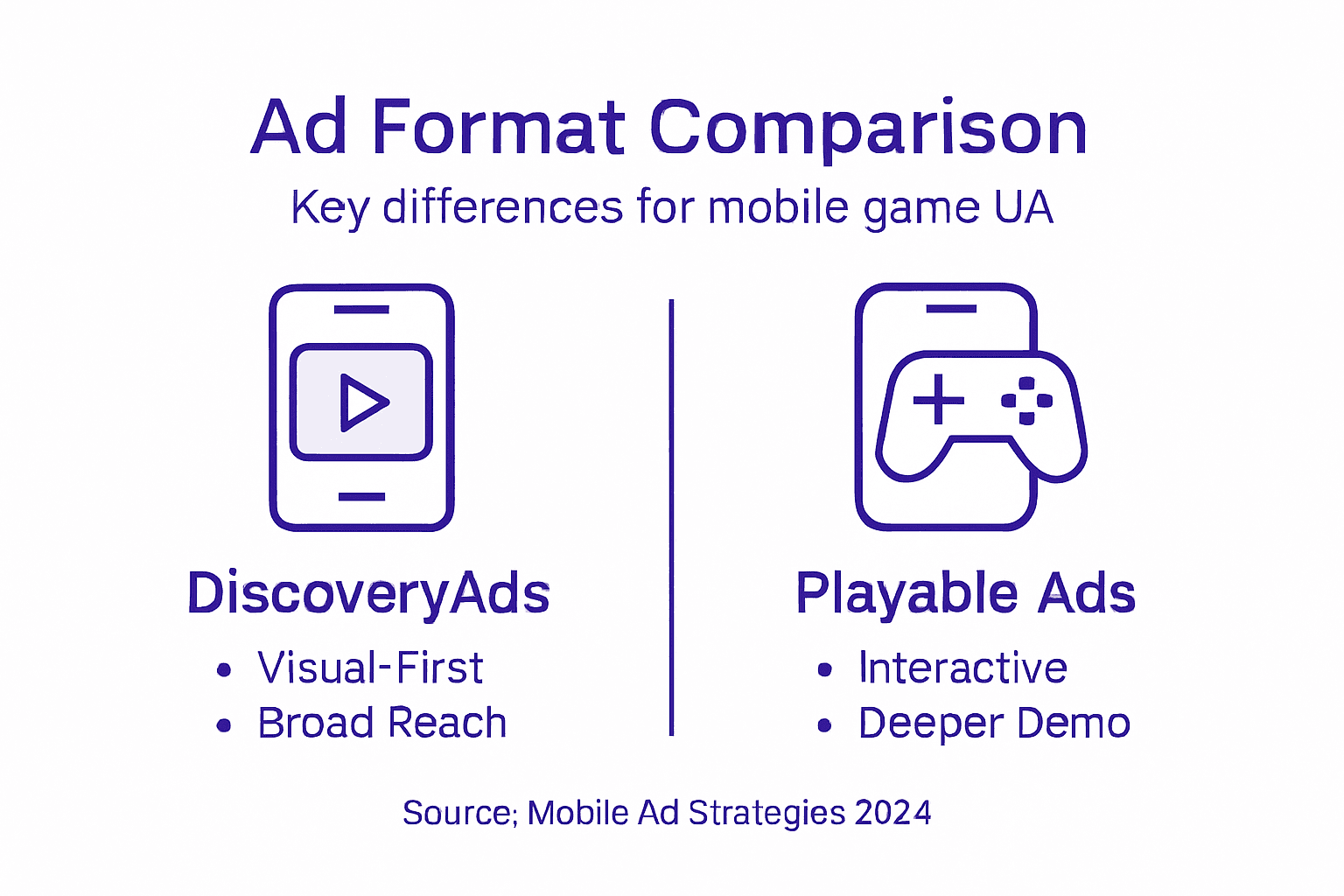
Here’s a comparison of Discovery Ads and playable ads for mobile games:
| Aspect | Discovery Ads | Playable Ads |
|---|---|---|
| Engagement Model | Visual-driven, passive interaction | Interactive, hands-on gameplay sample |
| Resource Requirements | Creative assets, simple setup | Development, coding, rigorous testing |
| Typical Use Phase | Awareness and broad reach | Conversion and high intent targeting |
| Key Strength | Scalable discovery with AI-powered targeting | Deep engagement and higher install intent |
| Limitation | May attract less committed users | Higher production cost and limited reach |
| Optimal For | Lean teams seeking fast iteration | Studios investing in high conversion rates |
Pro tip Start with Discovery Ads to build awareness and gather performance data about which game features resonate visually, then use those insights to design targeted playable ad experiences for your warmest audience segments.
Cost, Efficiency, and Common Pitfalls
Mobile game marketing consumes significant resources. Mobile game marketing typically demands around 25% of revenue, yet much of that spending produces disappointing returns when targeting and creative alignment suffer. Discovery Ads can feel like a solution to this cost challenge because they promise algorithmic efficiency and hands-off optimisation. The reality is messier. Without clear performance metrics like lifetime value or install-to-paying-user ratios, you can burn through budget quickly without knowing whether your ads are actually acquiring valuable players or simply generating cheap clicks from users unlikely to engage with your game long-term. The trap many startup teams fall into is treating Discovery Ads as a “set and forget” channel. You launch a campaign with reasonable-looking creatives, Google’s algorithm takes over, and you assume efficiency will follow. Then three weeks later you realise your cost per install has doubled and your day-one retention has tanked because your ads attracted exactly the wrong players.
Common pitfalls emerge when teams misalign their marketing and development efforts. Your marketing team might optimise for installs whilst your development team hasn’t addressed core game issues that cause first-day churn. You’re acquiring players efficiently only to lose them immediately. Another critical mistake is ad fatigue without creative rotation. Discovery Ads appear in high-traffic feeds where users see ads repeatedly. If you’re running the same three carousel sequences for six weeks, performance degrades as the same audience sees the same creative over and over. The algorithm still distributes your ads, but engagement and conversion drop because curiosity has worn off. Team oversight matters here. Over reliance on AI without human creative review leads to campaigns that technically perform within your target cost-per-action but attract the wrong audience. The algorithm optimises for what you tell it to optimise for, not for long-term game health.
Privacy regulation changes, particularly Apple’s App Tracking Transparency, have made discovery phase targeting more challenging by reducing the data available for precise audience segmentation. This means you must compensate by improving creative quality and message-audience alignment manually. A generic “Download Now” carousel won’t cut it. Your creatives must speak directly to specific player segments. Strategy game enthusiasts respond to different visuals than casual puzzle players. Without human oversight of targeting, you risk broad inefficient reach that looks cheap upfront but fails to convert into genuine players.
Budget allocation demands clear frameworks. Set predetermined cost-per-install targets based on your game’s lifetime value, not industry benchmarks. If your game monetises at £3 per player over 12 months and your operating margin is 40%, your sustainable cost per install sits around 60 pence. Not £1, not £2. Know this number before you launch any campaign. Split test your creative rigorously. Run four different carousel sequences simultaneously for one week. Measure not just clicks but installs and day-one retention. Pause the bottom two performers and create new variations based on what you learned.
Below is a summary of Discovery Ad campaign essentials for effective mobile game marketing:
| Success Factor | Description | Practical Tip |
|---|---|---|
| Creative Quality | Distinctive visuals capturing gameplay highlights | Use striking in-game moments |
| Audience Targeting | AI matches ad to user interests and intent signals | Refine with relevant player segment data |
| Performance Metrics | Measure installs, retention, and ROI | Set CPI targets based on real LTV |
| Iteration Cycle | Rapid creative testing and rotation | Replace underperformers weekly |
| Authenticity | Accurate representation of real gameplay | Avoid using misleading footage |
Pro tip Track your cost per download, cost per day-one retained user, and cost per paying user separately, then allocate budget only to campaigns where the cost per retained user sits below your target threshold, regardless of how cheap the raw cost per install appears.
Boost Your Mobile Game User Acquisition with Effortless Playable Ads
Discovery Ads have transformed mobile game marketing by reaching players during their most receptive moments. Yet, as the article highlights, crafting highly engaging playable ads often demands significant development resources and costs that many lean teams cannot afford. If your goal is to rapidly iterate and create rich interactive ad experiences without draining your budget or diverting precious developer time, our no-code platform offers the perfect solution.
At PlayableMaker, we empower mobile studios to build playable and interactive ads with ease and speed. You can test your creative ideas quickly while delivering authentic gameplay moments that resonate deeply with different player segments. Combine this with insights from the Publishing Archives to refine your marketing approach. Ready to overcome the resource challenges of traditional playable ad production and start scaling your user acquisition effectively Use our platform today at PlayableMaker and access expert support through our Help Archives. Don’t wait — transform your mobile game advertising now and connect with your ideal players in ways that Discovery Ads alone cannot achieve.
Frequently Asked Questions
What are Discovery Ads for mobile games?
Discovery Ads are visually rich, mobile-first advertisements that appear in users’ personalised feeds on platforms like Google Discover, YouTube, and Gmail. They leverage AI-driven targeting to reach potential players when they are exploring new content.
How do Discovery Ads differ from traditional search ads?
Unlike traditional search ads that interrupt a user mid-task, Discovery Ads engage users during a discovery mindset. They appear within feeds where users are browsing, making them feel more like discoveries rather than interruptions, thereby increasing the likelihood of user engagement.
What types of formats do Discovery Ads come in?
Discovery Ads primarily come in two formats: single-image ads, which showcase a compelling visual of the game, and carousel ads, which allow users to scroll through multiple images to learn about different features and aspects of the game.
How can I measure the effectiveness of Discovery Ads?
Effectiveness can be measured by tracking key performance metrics such as installs, day-one retention rates, and cost per install (CPI). It’s essential to set clear CPI targets based on the game’s lifetime value to ensure that your campaigns are acquiring valuable players.
Recommended
- Master User Acquisition Ad Strategies for Mobile Games – playablemaker.com Master User Acquisition Ad Strategies for Mobile Games
- Understanding What is User Acquisition in Mobile Gaming – playablemaker.com Understanding What is User Acquisition in Mobile Gaming
- Customer Acquisition Methods: Complete Mobile Gaming Guide – playablemaker.com Customer Acquisition Methods: Complete Mobile Gaming Guide
- Mastering Mobile Game User Acquisition Strategies in 2025 – playablemaker.com Mastering Mobile Game User Acquisition Strategies in 2025
- Spotlight Social Advertising | Expert Facebook & Instagram Ads Agency