More than 2.7 billion people worldwide play mobile games, creating fierce competition for their attention and loyalty. Mobile game developers face a complex challenge as acquiring new players often shapes the fate of a game. With quality players driving long-term success, understanding how to attract, engage, and retain users becomes crucial. By exploring the most effective methods and channels, game creators can transform their approach and stand out amid crowded app stores.
Table of Contents
- Defining Customer Acquisition Methods In Gaming
- Major Channels For Acquiring Users
- Paid Versus Organic Acquisition Strategies
- Metrics And Tracking User Acquisition Success
- Cost Considerations And Budget Efficiency
- Common Pitfalls And How To Avoid Them
Key Takeaways
| Point | Details |
|---|---|
| Effective Customer Acquisition | Combining demographic targeting, multi-channel marketing, and personalized user experiences is crucial for long-term player engagement in mobile gaming. |
| Balancing Paid and Organic Strategies | Developers should utilize both paid advertising for immediate growth and organic approaches for sustainable engagement and community-building. |
| Performance Metrics are Key | Continuous monitoring of acquisition cost, retention rates, and lifetime value is essential for refining user acquisition strategies. |
| Avoiding Common Pitfalls | Focus on player experience and targeted marketing to avoid pitfalls associated with aggressive monetization and ineffective audience segmentation. |
Defining Customer Acquisition Methods in Gaming
Customer acquisition in mobile gaming represents a strategic approach to attracting and converting potential players into active game users. According to digitalstrategies, this process involves sophisticated strategies utilizing demographic targeting, data analysis, and nuanced insights to effectively engage potential game enthusiasts.
Customer acquisition methods encompass a diverse range of techniques designed to expand a game’s player base. moldstud highlights several key approaches, including targeted advertising, influencer collaborations, referral programs, and community-driven events. These strategies work synergistically to attract, onboard, and retain new players in an increasingly competitive mobile gaming landscape.

Effective customer acquisition goes beyond simple player recruitment. It involves understanding player motivations, identifying optimal marketing channels, and creating compelling entry points that transform casual browsers into engaged game users. Mobile game developers must leverage data-driven insights, craft personalized user experiences, and continuously refine their acquisition strategies to stand out in a crowded marketplace.
Key components of successful customer acquisition include:
- Precise demographic targeting
- Multi-channel marketing approaches
- Compelling onboarding experiences
- Performance tracking and iterative optimization
- Engagement strategies that reduce player churn
Major Channels for Acquiring Users
Mobile gaming user acquisition demands a multi-channel approach that strategically targets potential players across various platforms. According to theseus, key acquisition channels include paid media campaigns, organic growth through app store optimization, and leveraging social media platforms to reach diverse audiences.
Paid advertising remains a cornerstone of user acquisition strategies. guarana-technologies highlights the effectiveness of in-app advertising, cross-promotions, and strategic partnerships with complementary apps and platforms. These targeted approaches enable game developers to connect with potential players who are most likely to engage with their specific game genre and style.
Beyond traditional advertising, successful user acquisition involves creating comprehensive, integrated marketing strategies. This means combining digital marketing techniques such as:
- Targeted social media advertising
- Influencer marketing collaborations
- App store optimization (ASO)
- Content marketing through gaming communities
- Referral and viral marketing programs
The ultimate goal is not just attracting users, but acquiring high-quality players who will become long-term, engaged members of the game’s community. This requires continuous analysis, refinement of targeting strategies, and a deep understanding of player preferences and behavior across different acquisition channels.
Paid Versus Organic Acquisition Strategies
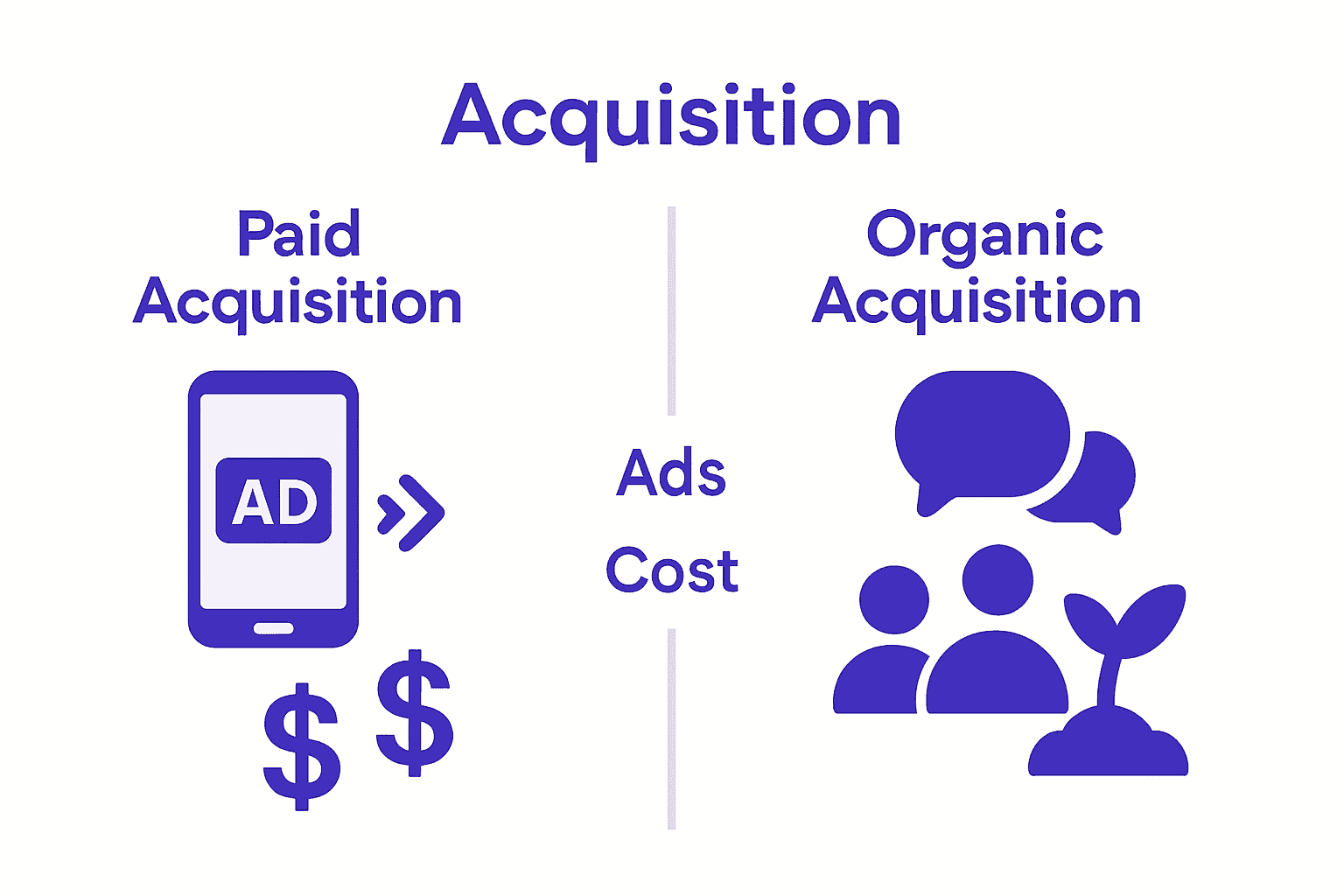
Mobile game developers face a critical decision when designing user acquisition strategies: balancing paid and organic approaches. According to theseus, these strategies differ fundamentally – paid acquisition involves direct investment in advertising campaigns, while organic strategies focus on enhancing app visibility and user engagement without direct advertising expenditure.
guarana-technologies emphasizes that successful user acquisition requires a nuanced balance between these methods. Paid strategies offer immediate, targeted reach and quick user influx, whereas organic approaches build sustainable long-term growth through genuine user satisfaction and community-driven word-of-mouth marketing.
Key differences between paid and organic acquisition strategies include:
Here’s a comparison of paid versus organic user acquisition strategies in mobile gaming:
| Aspect | Paid Acquisition | Organic Acquisition |
|---|---|---|
| Cost | High initial spend | Lower direct costs |
| User Growth Speed | Immediate and scalable | Slow, sustainable |
| Audience Targeting | Highly targeted | Broad, less precise |
| Retention Rates | Variable, often lower | Typically higher |
| Community Engagement | Limited | Builds authentic engagement |
| Long-term Value | Depends on optimisation | Fosters loyalty |
| Scalability | Easily adjustable | Gradual and cumulative |
-
Paid Strategies:
- Immediate user acquisition
- Precise audience targeting
- Quick scalability
- Higher initial investment
-
Organic Strategies:
- Lower direct costs
- Higher user retention rates
- Builds authentic community engagement
- Slower but more sustainable growth
Ultimately, the most effective user acquisition approach combines both paid and organic methods.
 Mobile game developers must continuously analyze performance metrics, adjust targeting strategies, and create compelling content that attracts and retains players across multiple channels.
Metrics and Tracking User Acquisition Success
Successful user acquisition in mobile gaming requires a comprehensive approach to measuring performance through key performance indicators (KPIs). According to arxiv, developers can leverage advanced analytical techniques like the Mean Cumulative Function to estimate expected user values over time, providing crucial insights into acquisition strategy effectiveness.
arxiv highlights the importance of sophisticated modeling techniques, particularly in improving customer lifetime value assessment. This involves expert routing and identifying high-value players, often referred to as “game whales,” which can significantly enhance the precision of user acquisition metrics and overall strategy.
Critical metrics for tracking user acquisition success include:
- Acquisition Cost (CAC)
- Total marketing spend divided by new users
- Indicates financial efficiency of acquisition strategies
- Retention Rate
- Percentage of users returning after initial download
- Measures long-term user engagement
- Lifetime Value (LTV)
- Predicted revenue from a user throughout their engagement
- Helps determine sustainable acquisition strategies
By continuously monitoring and analyzing these metrics, mobile game developers can refine their user acquisition approaches, optimize marketing spend, and create more targeted, effective player recruitment strategies. The goal is not just acquiring users, but attracting high-quality players who will engage with the game long-term.
Cost Considerations and Budget Efficiency
User acquisition budgeting represents a critical challenge for mobile game developers seeking to maximize return on investment. According to business, understanding the cost per install (CPI) across different game genres is essential for developing strategic and efficient marketing approaches.
theseus emphasizes the importance of regional analysis in user acquisition cost management. Different markets can significantly impact acquisition expenses, requiring developers to tailor their budgeting strategies to specific geographical and demographic contexts.
Key budget efficiency strategies include:
- Precise Targeting
- Narrow audience segmentation
- Reduce wasted ad spend
- Improve conversion rates
- Channel Diversification
- Spread investment across multiple platforms
- Mitigate risk of single-channel dependency
- Optimize cost-per-acquisition
- Performance Monitoring
- Continuous metric tracking
- Quick budget reallocation
- Eliminate underperforming campaigns
Successful mobile game developers recognize that cost efficiency is not about minimizing spending, but maximizing the value of every marketing dollar. This requires a dynamic, data-driven approach that continuously adapts to changing market conditions and player preferences.
Common Pitfalls and How to Avoid Them
User acquisition strategies in mobile gaming are fraught with potential missteps that can derail even the most well-intentioned marketing efforts. According to arxiv, one of the most significant risks is an overemphasis on monetization that neglects player engagement, which can ultimately erode user trust and compromise long-term success.
arxiv highlights another critical pitfall: failing to conduct comprehensive user behavior analysis and market segmentation. Understanding player clusters and personalizing acquisition approaches is fundamental to developing targeted, effective marketing strategies that resonate with specific audience segments.
Common user acquisition pitfalls to avoid include:
- Ignoring Player Experience
- Prioritizing short-term gains over user satisfaction
- Implementing aggressive monetization strategies
- Neglecting game quality and player enjoyment
- One-Size-Fits-All Marketing
- Using generic, non-targeted advertising
- Failing to segment audience demographics
- Wasting resources on irrelevant user groups
- Inadequate Performance Tracking
- Lack of comprehensive metric analysis
- Slow response to changing market conditions
- Inability to pivot strategies quickly
Successful mobile game developers must adopt a holistic, nuanced approach that balances user acquisition efficiency with genuine player value, continuously adapting their strategies to meet evolving market dynamics and player expectations.
Simplify Your Mobile Game User Acquisition with Effortless Playable Ads
The challenge of mastering customer acquisition methods in mobile gaming often comes down to how quickly and cost-effectively you can engage and convert players. This article highlights the importance of targeted acquisition strategies, balancing paid and organic growth, and the necessity of optimising your marketing budget while delivering compelling player experiences. If you have struggled with complex, expensive ad creation that drains your team’s resources, you are not alone.
At PlayableMaker, we understand the pain points of lengthy development cycles and high costs tied to playable ads that are critical for effective user acquisition. Our no-code platform empowers you to build interactive ads fast and budget-friendly, enabling you to launch campaigns that capture player attention across multiple channels seamlessly. Stop wasting time and money on traditional ad development and start leveraging tools designed for quick scalability, precise targeting, and authentic engagement.
Ready to take control of your mobile gaming user acquisition strategy? Discover how easy creating powerful playable ads can be by visiting PlayableMaker’s landing page. Transform your marketing approach today and unlock better retention and higher lifetime value with ads that truly resonate. Act now to gain the competitive edge your game deserves.
Frequently Asked Questions
What are the main methods for customer acquisition in mobile gaming?
Customer acquisition methods in mobile gaming include targeted advertising, influencer collaborations, referral programs, and community-driven events. These strategies aim to engage potential players and expand a game’s user base.
How do paid and organic acquisition strategies differ?
Paid acquisition strategies involve direct investments in advertising for immediate user growth, while organic strategies focus on enhancing app visibility through user engagement without direct advertising costs, leading to sustainable, long-term growth.
What key metrics should be monitored to measure user acquisition success?
Critical metrics for tracking user acquisition success include Acquisition Cost (CAC), Retention Rate, and Lifetime Value (LTV). These metrics provide insights into the effectiveness and efficiency of acquisition strategies.
What common pitfalls should developers avoid in user acquisition?
Developers should avoid overemphasis on monetization at the expense of player engagement, using one-size-fits-all marketing tactics, and inadequate performance tracking. Understanding player preferences and continuously analyzing metrics is essential for success.
Recommended
- Understanding What is User Acquisition in Mobile Gaming – playablemaker.com Understanding What is User Acquisition in Mobile Gaming
- Master User Acquisition Ad Strategies for Mobile Games – playablemaker.com Master User Acquisition Ad Strategies for Mobile Games
- Understanding User Acquisition Strategy for Apps – playablemaker.com Understanding User Acquisition Strategy for Apps
- The Five Best Tools for Gamification | TerraHunt